Stories and advice from Jaxon Forge, Founder of MoneyForged.com
Raw, no-fluff truth on wealth psychology, iron discipline, free-market capitalism, tariffs, and the systems that separate the self-made from everyone else.
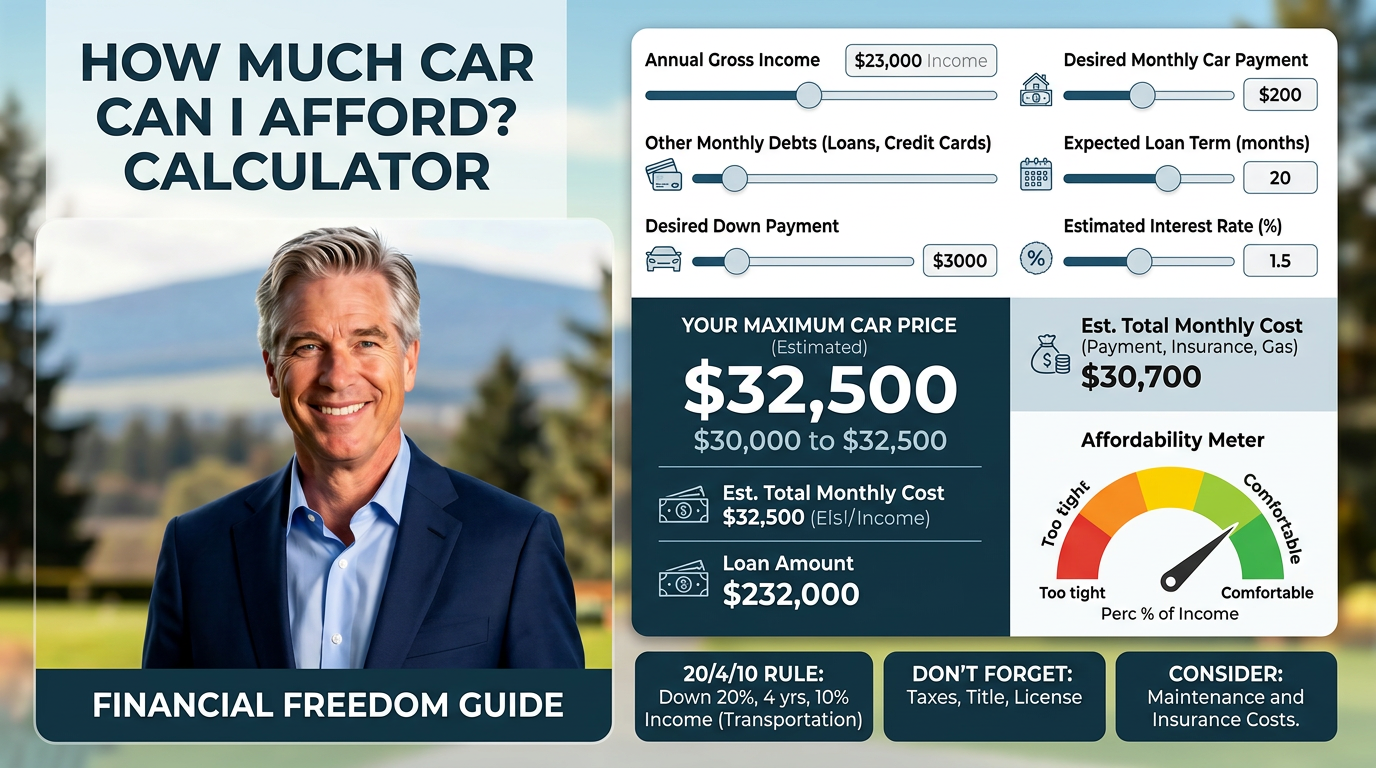
Using the classic 20/4/10 Rule, let’s find a car budget that keeps you on the path to prosperity. No debt traps here!
$
After taxes (what actually hits your bank account)
%
Average used car rates are between 6% – 10%
Your Maximum Purchase Price
$20,879
Max Monthly Payment (10%):$400
Target Down Payment (20%):$4,176
Loan Term:48 Months (4 Years)
How Much Car Can I Afford (And Why Most People Get It Wrong) | Jaxon Forge – MoneyForged.com
MoneyForged.com
Stories and Advice from Jaxon Forge
How Much Car Can I Afford (And Why Most People Get It Wrong)
By Jaxon Forge, Founder of MoneyForged.com
March 2026
I remember the exact moment I almost blew it.
Business had just hit consistent six figures. First big bonus landed. Instead of wiring it to investments or the mortgage, I started shopping trucks. Bigger, newer, leather everything. “I’ve earned this,” I told myself. “Reliable ride for client meetings. Safety. Comfort.”
Sound familiar?
That’s lifestyle inflation in real time. Income goes up, so the car payment goes up faster. You don’t feel extravagant because it’s “just” a step up from before. But over months and years, that upgrade becomes baseline. Your freedom shrinks while the shiny thing in the driveway sits there depreciating 20% the second you drive it off the lot.
I stopped myself before signing. Kept driving the same reliable truck for another three years. That decision alone probably added six figures to my net worth through compounding. Here’s the raw truth most people miss: the question isn’t “Can I afford the payment?” It’s “Is this car stealing my future freedom?”
The Silent Killer: Comfort Masquerading as “I Deserve It”
High earners stay broke because they treat upgrades like rewards instead of risks. You get the raise, lease the luxury SUV, post the pics, feel on top. Then the payment hits every month like clockwork. Insurance jumps. Gas jumps. Maintenance jumps. Suddenly you’re working harder just to maintain the image.
Real example: I knew a surgeon pulling $350k/year. Nice house, private school for kids, vacations every quarter. But he was always stressed. Why? His $1,200/month car lease (plus $300 insurance) ate what could’ve been investments. He upgraded every three years “because the warranty was up.” Hedonic treadmill on wheels. Looked rich. Felt trapped.
Another one: Tech guy friend hit $200k after a promotion. Immediately leased a $90k Tesla. “It’s an investment in myself,” he said. Two years later, job slowed, payments stayed. He was one layoff from panic. The car didn’t build wealth—it built a cage.
Comfort zones are cemeteries for ambition. A nicer car feels like balance. It’s not. It’s trading long-term freedom for short-term dopamine.
The Rules I Live By: How Much Car Can You Actually Afford?
20/3/8 Rule (My Go-To Framework)
– Put at least 20% down (avoid being underwater).
– Finance for no more than 3 years (short term kills interest drag).
– Total car payment (including insurance, gas, maintenance) ≤ 8% of gross monthly income.
Example: $10k/month gross? Max $800/month all-in on car stuff. Keeps you lean and investing the rest.
10-15% of Take-Home on Payments Only
Most experts say car payment ≤10% of net pay. I push 10% max for new, 15% only if used and paid fast. Anything higher and you’re funding depreciation instead of compounding.
Total Vehicles ≤ 50% of Annual Income
Unless your net worth is $1M+, don’t let all your cars combined exceed half your yearly gross. Keeps ego in check and capital working.
Pay Cash If Possible
If you can’t buy it outright (or close), you probably can’t afford it. Debt on a depreciating asset is wealth poison.
Delay the Upgrade
When bonus hits, fund freedom first: extra principal, investments, “screw you” fund. Delay gratification on the visible stuff. The gap widens while friends look richer—you actually get richer.
The Real Math: What a “Deserved” Upgrade Costs You
Let’s say you make $150k/year ($8k take-home/month after taxes). You “upgrade” to a $70k car with $800/month payment (10% of take-home—already at the edge).
Over 5 years: ~$48k in payments + interest + extra insurance/gas/maintenance ≈ $60k total.
Invest that $60k at 10% average return instead? In 10 years ≈ $155k. In 20 years? Over $400k.
One “deserved” car stole a house down payment or early retirement chunk. That’s not theory—that’s math.
Bottom Line: Stay Hungry, Drive Boring
I still drive a truck that’s paid off. It’s not sexy. It hauls what I need and gets me where I’m going. Friends upgraded years ago. They look successful. I’m free.
If you want wealth that buys real options—not just nicer seats—treat the car like what it is: a tool, not a status symbol. Pay the discipline tax early. Delay the upgrade. Let compounding do the heavy lifting.
Because the moment you say “I deserve the nicer car,” comfort has already started winning.
Tap, Click, or press Spacebar to jump. Double-tap in mid-air to double jump! Dodge fences, foxes, wolves, and Bear Markets.
Liquidated!
You hit an obstacle and lost your assets.
Final Compounded Flock: 1
1
🐑
The Sheep That Won’t Let You Scroll Past Your Potential
I built Sheep Grinder not because I love games, but because I hate excuses.
Most nights when I was still climbing out of the debt-and-comfort trap, I’d lie in bed replaying tomorrow’s to-do list like a broken record. The mind wouldn’t shut off. Anxiety about money, clients, the next move—it all kept sleep at arm’s length. Then I’d wake up groggy, hit snooze, lose the first golden hour, and wonder why my discipline felt like quicksand.
That cycle ends when focus becomes a muscle you train before your eyes even close.
Sheep Grinder is brutal in its simplicity: one sheep charges the fence. You have a tiny window—SPACEBAR or tap—to count it precisely as it jumps. Nail it, the speed ramps. Miss, game over. No second chances, no “almost,” no “I’ll get it next time.” Just reset and pay the discipline tax again.
I run it every night for 10–15 minutes. Not to win high scores (though 478 is my current mark). I run it to practice ruthless timing under pressure. Every perfect count is a micro-rep for staying locked in when the real-world deal is closing, the market is moving, or the 4:30 a.m. alarm hits and every cell screams “five more minutes.”
The scrolling sheep above this post? That’s your reminder.
Every time you catch yourself mindlessly scrolling feeds, refreshing notifications, or doom-looping comments—picture that sheep. It’s charging straight at the fence of your attention span. You either count it (focus, act, decide) or you miss it (scroll past, delay, stay comfortable). The longer you let it scroll by without engaging, the faster the next one comes, until the whole night is gone and you’re still exactly where you were yesterday.
Wealth isn’t built in the moments you feel motivated. It’s built in the moments you refuse to let the sheep scroll past unchecked.
So tonight, when the screen glows and your thumb hovers, remember:
One precise tap = one disciplined choice
One missed jump = another night paid to comfort
Rack enough perfect counts = wake up tomorrow with a mind that doesn’t negotiate with weakness
Forge that habit before bed. Let the sheep teach you what no guru video ever could: precision under escalating pressure is the real compound interest of the mind.
Grind the game. Grind the routine. Grind the life.
Smash debt like it’s 3 AM and you’re the only one awake. Snowball vs Avalanche—see the numbers glow when you win.
Hey forge crew, what’s good? It’s Jaxon Forge here, founder of MoneyForged.com, and welcome back to the channel. If you’re one of the 292,000 of you grinding alongside me—and that number keeps climbing every single day—thank you for showing up. That means you’re not just consuming content. You’re hunting for the real playbook, the stuff that actually moves money in your direction instead of bleeding it out the back door.
Today we’re going deep on one of the topics I get asked about most in the comments and DMs: how to pay down debt faster in 2026. Not the fluffy Dave Ramsey memes or the TikTok hacks that fall apart in month two. Real, battle-tested strategies I used to dig myself out of a $45,000 hole in my early 20s—credit cards, student loans, a car note that felt like a noose. I was making decent money even back then, but every dollar was disappearing faster than it arrived. Comfort masquerading as “balance” had me convinced minimum payments were fine. They weren’t. Interest was compounding against me like a silent killer, turning what should have been temporary debt into a permanent tax on my freedom.
I clawed my way out in under three years and turned that pain into my first $100k net worth without a fancy degree or rich parents. If you’re sitting there right now with balances staring you in the face, heart rate spiking every time the mail comes, this episode is for you. We’re covering what actually works, the math behind it, and—more importantly—the stuff that sounds good but keeps most people broke forever.
Let’s start with the foundation most skip: face the battlefield.
Open every statement. Every single one. Write it down or plug it into a spreadsheet or Undebt.it—whatever tool you like. Debt name, current balance, interest rate, minimum payment. No sugarcoating. When I did this for the first time, the total number hit like a punch. But hiding from it only lets interest keep winning. You can’t kill what you won’t look at.
Now the strategies that actually accelerate payoff.
First and non-negotiable: pay more than the minimum. Every time. Minimum payments are designed by banks to keep you in debt for decades. On a typical credit card, the minimum might cover mostly interest with pennies toward principal. Even an extra fifty bucks a month changes the trajectory dramatically.
Quick example I still use when people DM me their numbers: five grand on a credit card at twenty percent APR, minimum payment around a hundred bucks. Pay only minimum? You’re looking at nine years and change, plus almost six grand in interest alone. Add just fifty extra per month? You cut the timeline in half and save thousands in interest. In 2026, with average credit card rates still sitting between nineteen and twenty-five percent, every extra dollar you throw at principal is buying you freedom faster.
Automate it. Set it and forget it. The day after payday, make the extra payment hit automatically. I treated mine like rent—non-negotiable. Remove the decision fatigue.
Next level: choose your attack method. There are two main roads here, and both work depending on your wiring.
Option one: debt avalanche. This is the math purist’s favorite. Rank your debts from highest interest rate to lowest. Pay minimums on everything else, then dump every extra dollar into the highest-rate debt until it’s dead. Then roll that full payment to the next highest.
Why it crushes: high-interest debt grows fastest. Killing the twenty-two percent card first stops the bleeding quicker than anything else. Over the long run, you pay the least total interest. When I ran my numbers back in the day, avalanche saved me several thousand compared to just winging it.
Option two: debt snowball. This is Dave Ramsey’s signature move, and it saved my motivation when I was burned out. Rank debts from smallest balance to largest, ignore the rates. Minimums on everything, extra cash goes to the smallest balance. Pay it off fast, get the quick win, roll that payment forward like a snowball picking up speed.
The power here isn’t the math—it’s the psychology. When you’re buried, seeing an entire debt disappear in a couple months gives you proof you can win. I knocked out a fifteen-hundred-dollar store card first. That victory lit a fire I hadn’t felt in years. If motivation is your weak link, start here. You might pay a little more interest overall, but you’ll actually finish.
I blended both. Started with snowball to build momentum, then switched to avalanche once the small ones were gone. Pick what keeps you in the fight longest.
Third accelerator: consolidation or balance transfers—if done right.
Move high-rate debt to a lower-rate spot. Zero-percent intro APR balance transfer cards (usually twelve to twenty-one months, three to five percent fee) or a personal consolidation loan at single-digit rates. I transferred a chunk of my nineteen-percent cards to a zero-percent promo once. Freed up cash flow immediately.
Critical rules though: only do this if the new effective rate is meaningfully lower. Shop aggressively—use sites like LendingTree or Credible. And freeze the old cards. Cut them up if you have to. I learned that the hard way—transferred once, then mindlessly charged the old card again. Dug the hole deeper. Don’t repeat my mistake.
Fourth: attack from both sides—income up, expenses down.
Debt payoff isn’t just defense; it’s offense. I rewired my brain to crave hard work instead of comfort. Trained myself to wake at four-thirty without an alarm. Side hustles became non-negotiable. Freelancing, consulting, turning one boring skill into multiple income streams. Even five hundred to a thousand extra a month changes everything.
On the cut side: track every dollar. I used to think I was “frugal” until I actually tracked. Subscriptions, eating out, impulse buys—found three hundred a month easy to reclaim. Call creditors and negotiate rates. “I’ve been a good customer for years—can you drop my APR?” I got one card from eighteen to twelve percent just by asking.
Last resort only: debt management plans or settlement through a nonprofit like NFCC. They can negotiate lower rates or lump-sum payoffs at thirty to fifty cents on the dollar. Hurts credit short-term, but can be a lifeline if debt is over fifty percent of your income. I never went there, but I know guys who did and came out the other side.
Now the brutal truth—what doesn’t work and why most people stay stuck.
Paying only minimums. Slow financial suicide.
Using new debt to pay old debt without a freeze on spending. Classic trap.
Chasing motivation instead of building systems. Motivation is a visitor; discipline is a resident.
Ignoring the root: debt is often unexamined fear dressed up as laziness. Until you face why you’re spending to feel better, you’ll keep rebounding.
No lifestyle change. You can’t out-earn reckless habits forever.
My simple framework that got me free and keeps me free:
One: full inventory—no hiding. Two: pick avalanche or snowball based on your psychology. Three: automate extra payments and treat them like oxygen. Four: boost income and cut ruthlessly—aim for at least twenty percent of take-home going to debt. Five: track weekly. Small progress compounds. Six: celebrate privately. Grind in silence. Posting wins early invites distraction.
When the last payment clears? Do the private scream. I did. Felt like chains falling off.
Forge crew, 2026 is still early. Rates are high, but so is opportunity if you move now. Pay the discipline tax early or pay interest forever. The choice is yours every single day.
If this episode hit you square in the chest, drop your current total debt number in the comments below—one number, no story needed. Just the truth. Seeing thousands of you own it publicly creates accountability like nothing else.
Smash that like button if you’re committing to extra payments this week. Subscribe and turn on notifications so you never miss the next no-BS drop.
You’ve got the playbook now. No more excuses.
Until next time—grind harder than yesterday. Forge your wealth. I’ll see you in the comments.
7 Pathways to Financial Prosperity — MoneyForged Blueprint
7 Pathways to Financial Prosperity
A battle-tested blueprint for turning good income into unbreakable wealth — no hype, no shortcuts, just systems that compound.
From the trenches at MoneyForged.com
Pathway 1: Cultivate a Prosperity Mindset
The foundation of any financial ascent starts in the head. Most people stay stuck because they view money as a scarce resource to be chased, not a tool to be mastered. A prosperity mindset shifts that: it’s about seeing opportunities where others see obstacles, embracing discomfort as fuel, and rewiring habits to crave progress over comfort.
High performers don’t chase motivation; they build systems. Instead of waiting for inspiration to save, they automate 20% of every paycheck into investments. This isn’t talent—it’s choice. Lies like “I’ll start when I have more time” or “I need balance first” keep 99% in mediocrity. Break through by examining fears: laziness often masks unaddressed anxiety about failure.
Start with daily action: list three wins every night to train your brain for momentum. Behavioral economics shows consistent small actions compound into massive shifts—much like interest on savings. Avoid comfort zones; they’re ambition cemeteries. Turn boredom into a weapon: use downtime to study markets or skills.
Question every expense: does it build prosperity or drain it? Pay the discipline tax early—skip instant gratification for long-term gains. The result? A mental framework where hard work feels natural, and opportunities multiply. Without this base, the other pathways crumble.
Pathway 2: Establish Financial Discipline
Discipline isn’t sexy, but it’s the engine. This pathway creates rules that force consistency, turning chaotic finances into a machine. Why do most stay broke despite good incomes? Leaks—unexamined spending, debt traps, no systems.
Track every dollar. Categorize into needs, wants, investments. Rule: live on 50-60% of income, save 20%, invest 20%. Build a $10k “Screw You” Fund—3-6 months of living expenses. It buys freedom from pressure-driven bad decisions.
Negotiate everything—salaries, bills, purchases. A 10% raise compounds into hundreds of thousands over a career. Avoid lifestyle inflation: when income rises, upgrade the portfolio, not the lifestyle.
Set auto-transfers, cut subscriptions ruthlessly, enforce a 48-hour rule for non-essentials. Discipline extends to time—own the quiet hours. Pay this tax early, or pay forever in regret.
Math example: cut $200/month waste. Over 10 years at 7% return, that’s over $30,000. Discipline isn’t restriction; it’s leverage.
Pathway 3: Harness the Power of Compounding
Listen, if there’s one thing that separates people who build serious, lasting wealth from everyone else, it’s this: they treat time like their most valuable partner, not their enemy. Compounding isn’t sexy. It doesn’t make headlines. It doesn’t go viral. But it is the quiet force that turns small, consistent moves into fortunes while everyone else is chasing the next shiny thing.
Picture this: you drop a single snowball at the top of a hill. At first, it’s tiny—just a handful of snow. But as it rolls, it picks up more snow. The bigger it gets, the faster it grows. That’s compounding in action. Your money earns returns, then those returns start earning returns on themselves. Interest on interest. Growth on growth. It’s not linear; it’s exponential. And once that curve starts bending upward, it bends hard.
Most people never feel this because they wait too long to start. They think, “I’ll invest when I have more money,” or “when the market looks perfect,” or “after I pay off everything.” Big mistake. Time is the real multiplier here—not the amount you start with, not even the rate you earn (though higher is better). The earlier you begin, the more ridiculous the end number looks.
Let me paint it with a simple story everyone gets. Say you stash away $10,000 today in a solid, boring investment—like a broad stock market index fund. Historically, the S&P 500, with dividends reinvested, has delivered around 10% average annual returns over long stretches, though let’s use a conservative 7% to keep it real and account for some fees or inflation dips.
At 7% compounded annually, after 30 years that $10,000 doesn’t just grow to $30,000 or $40,000. It turns into roughly $76,000. You’ve made $66,000 in gains—more than six times your original stake—without adding another dime. If the account compounds monthly (which most do), it’s even better: closer to $81,000.
Now flip the script. What if you wait 10 years to start? Same $10,000, same 7%. But now you’ve only got 20 years for it to work. End result? About $39,000. You lose almost half the potential just by delaying a decade. That’s not a small difference; that’s life-changing money left on the table because time wasn’t respected.
But here’s where it gets even more powerful—and this is the part I hammer home to anyone starting out. You don’t have to rely on a one-time lump sum. Add consistently, and the snowball rolls faster.
Imagine you start with that same $10,000, but then you commit to adding just $200 a month—about what most people waste on takeout or unused subscriptions. At 7% with monthly compounding, over 30 years you’re looking at over $325,000. That’s not luck. That’s math doing its job. Your contributions total around $82,000 over those years ($10k initial + 360 × $200), but the compounding turns it into nearly four times that.
The lesson? Start small, start now, stay consistent. Automate it—set up the transfers so the money disappears before you can spend it. Reinvest every dividend, every return. Don’t touch it. Let time and patience do the heavy lifting.
A few rules I live by to make this pathway unbreakable:
Never interrupt compounding once it starts. Pulling money out early kills the momentum—like stopping the snowball mid-roll.
Focus on what you can control: the rate of contribution and the time horizon. You can’t predict markets perfectly, but you can predict that consistent 7-10% over decades is realistic for diversified equities.
Avoid the hype traps. Flashy 50% returns sound great until they crash to zero. Boring, steady compounding beats gambling every time.
Think in decades, not months. The real explosion happens in the back half—years 20 through 30 or 40. That’s why the young grinder who starts at 25 looks like a genius by 55, even if they weren’t the highest earner.
Compounding is patient. It’s silent. It rewards the disciplined over the flashy. Ignore it, and you’re choosing to stay average. Respect it, and it becomes your unfair advantage. This isn’t theory—it’s the engine behind every self-made fortune that lasts. Start the snowball today. By the time you notice how big it’s gotten, you’ll wonder why you ever waited.
Pathway 4: Diversify Income Streams
One paycheck = single point of failure. Prosperity comes from multiple streams: salary, side hustles, investments, passives. This spreads risk and accelerates growth.
Start small: turn skills into cash. Tech? Freelance. Creative? Digital products. Layer 2-3 aligned hustles—blog → affiliates → courses. Prioritize recurring revenue over one-offs.
Passive plays: rentals (cash flow > net worth), dividends, boring businesses. Spot BS: quick riches with no effort = run. Three streams at $2k/month each = $72k/year. Compound 20% savings at 8% → over $1M in 20 years.
Hidden leverage: boring niches print money with low competition. Test ideas in 90 days. This pathway turns time into assets, ending the hours-for-dollars trade.
Pathway 5: Invest Intelligently
Investing isn’t gambling—it’s calculated capital placement. Skip what you don’t understand; focus on proven vehicles.
From $0 to accredited: consistent 15-20% savings invested at 7-10% gets you there in 20-30 years. Dollar-cost average—buy fixed amounts regularly, capture lows automatically.
Tax moves: max retirement accounts for tax-free growth. Turned $5k into $50k? Reinvest in indexes, let compounding run 15+ years at 8%. Mental model: money as soldiers—deploy them to capture territory.
Pathway 6: Build and Scale Enterprises
Prosperity peaks when you own the game. $0 startup blueprint: validate fast, launch MVPs. Run side hustles while employed—nights for building.
Models: service (consulting), product (e-com), content (newsletters). Price high for value; fire bad clients. Scale via delegation—free time for growth.
One-man empire: automate with tools. Cold outreach focusing on value lands big contracts. Avoid viral chases; build moats with recurring revenue and personal brands. Boring niches still win in 2026.
Plan exits early. This pathway multiplies efforts—one business funds the next, creating real leverage.
Pathway 7: Sustain Through Habits and Reflection
Prosperity isn’t a destination—it’s maintenance. Habits keep the engine running: structured routines, health for sharpness, family for grounding.
Reflect: ask “Does this align?” before big decisions. Handle burnout with walks, biographies for perspective. Stay hungry after success; patience is the ultimate hack.
Legacy: build without ego. Integrity compounds long-term. What you’d tell your 20-year-old self: start compounding now, reject shiny objects, grind in silence.
These pathways form a code for unbreakable prosperity. Implement one at a time, adjust, execute. The compound effect does the heavy lifting.
Trump Account Night Mode Compounder – Forge Your Legacy
Trump Account Night Mode Compounder
Grind in the Shadows – Build Wealth That Lasts Generations
Future Value at Target Age:
Total Contributions:
Inflation-Adjusted Value:
Growth from Compounding:
Year-by-Year Breakdown
Year
Balance Start
Contribution
Growth
Balance End
Annual compounding base; adjusts for frequency. Past returns ≠ future. Tax-deferred assumed. Max $5k/year. Consult pros. “Pay the Discipline Tax Early or Pay It Forever” – start now.
In 2026 the government started handing every eligible newborn (born 2025–2028) a $1,000 tax-advantaged investment account invested in low-cost U.S. stock index funds. Parents can add up to $5,000 a year (post-tax, inflation-adjusted later). The money grows tax-deferred until the kid turns 18, then follows traditional IRA rules.
This isn’t hype—it’s boring, relentless compounding doing what it’s done for decades.
Realistic projections using historical S&P averages (~10% nominal annual return):
Just the $1,000 seed, zero extra contributions → ~$5,600–$6,000 by age 18 → ~$15,000–$16,000 by age 28 → ~$500,000–$800,000+ by age 65
Max $5,000/year contributions from day one → ~$220,000–$300,000 by age 18 → ~$800,000–$1.1 million+ by age 28 → Multi-million-dollar range by retirement (often $3M–$8M+ depending on exact returns and inflation)
Even conservative 7% returns still deliver life-changing numbers because time is the variable most people refuse to pay for.
I built a free, browser-based calculator in dark night mode so you can run your own scenarios without eye strain:
Input child’s current age, target age (18, 28, 65, whatever), seed amount, annual contribution, return rate, inflation rate, compounding frequency (monthly/quarterly for extra precision)
See nominal future value, inflation-adjusted real value, total growth from compounding, year-by-year breakdown table, and an exponential growth chart that makes the math impossible to ignore
One-click print (clean single page) or PDF export so you can pin it to the wall or show the family
Why this tool exists: Most families will ignore the program, cash out early, or never fund it. The 1% who claim the free $1,000, max contributions consistently, and let it sit untouched for decades will quietly build generational wealth while everyone else is still chasing the next shiny thing.
This is “The Compounding Cheat Code Most People Ignore” and “The Real Math Behind Getting Rich Slowly” handed to you on a government platter. In Portland right now you’re in perfect position—newborns from last year are already eligible, accounts are live, Form 4547 or the portal is open.
Run the numbers tonight. See what 18–65 years of discipline looks like in dollars. Then decide if you’re willing to pay the discipline tax early… or pay it forever in missed opportunity.
Copy-paste the code, open it in your browser, plug in your kid’s details. The chart will do the rest.
See how long it takes your money to double—and watch the exponential curve build over time.
Enter Expected Annual Return (%)
Year-by-Year Doubling Milestones
Number of Doublings
Rule of 72 Years
Exact Years
Balance (from $1)
40-Year Growth Chart (Starting with $1, no additions)
This chart shows exponential growth at your rate. Notice how the line stays flat early, then curves sharply— that’s compounding at work. The Rule of 72 helps you quickly estimate doublings without calculating every year.
The Rule of 72: The Mental Shortcut That Changed How I See Wealth
I used to think getting rich was about working harder, hustling longer, or finding the next big thing. Then I learned the Rule of 72, and everything flipped.
It’s embarrassingly simple: divide 72 by your annual rate of return (in percent), and you get the approximate number of years it takes for your money to double.
6% return → 72 ÷ 6 = 12 years to double
8% return → 72 ÷ 8 = 9 years
12% return → 72 ÷ 12 = 6 years
That’s it. No calculator needed, no spreadsheet, no finance degree. You can do it while pouring concrete, driving between jobs, or waiting for coffee. But don’t let the simplicity fool you—this little trick exposes the single biggest lever in wealth building that most people never touch: time.
Back in my 20s, I was making decent money on job sites but spending it faster than it came in. Cars, nights out, “investments” that were really just expensive hobbies. I thought wealth was about how much I earned in a year. Then someone handed me the Rule of 72 on a napkin, and I ran the numbers backward.
If I could average 8% long-term (roughly what the stock market has done after inflation over decades), my money would double every nine years. Start with $10,000 at 25:
Age 34: $20,000
Age 43: $40,000
Age 52: $80,000
Age 61: $160,000
Four doublings in 36 years, and that’s without adding another dollar. Now add $200 a month—the kind of money you can carve out of a concrete paycheck—and the numbers explode because each contribution gets swept into the compounding engine.
The math behind the rule is elegant. It comes from the compound interest formula. To double your money:
2 = (1 + r)^t
Take the natural log:
ln(2) = t × ln(1 + r) t = ln(2) / ln(1 + r) ≈ 0.693 / r
Multiply numerator and denominator by 100 to work with percentages, and you get roughly 69.3 / r%. But 69.3 isn’t friendly for mental math. 72 is—divisible by 2, 3, 4, 6, 8, 9, 12. The approximation is damn close in the 6–10% range most realistic long-term investors live in. At 8%, the error is basically zero. At higher rates it gets optimistic; at lower rates slightly pessimistic. But for everyday use? It’s gold.
Here’s where it gets brutal: the difference between starting at 25 versus 35 is one extra doubling. That’s not “a little more time”—that’s literally twice the outcome for the same effort. I tell people all the time: the Discipline Tax you pay in your 20s and 30s (saying no to dumb purchases, automating investments, living below your means) is the cheapest tax you’ll ever pay. Delay it, and you pay forever in lost doublings.
Inflation works the same way in reverse. At 3% average inflation, your purchasing power halves every 24 years (72 ÷ 3). That’s why sitting in cash long-term is a slow bleed. The Rule of 72 doesn’t just show growth—it shows decay.
I’ve used this rule on every major financial decision since my mid-20s. When evaluating a side hustle, I ask: “If I reinvest the profits at X%, how many doublings can I realistically get in the next 20 years?” When someone pitches me a “can’t-miss” opportunity promising 30% returns, I run 72 ÷ 30 = 2.4 years to double… then ask why they’re selling it instead of keeping it. High promised returns usually come with high risk or hidden catches—the rule keeps me honest.
The real power isn’t in memorizing 72. It’s in internalizing what it represents: time is the only variable you can’t buy back. Returns matter, contributions matter, but time multiplies everything. Start early, stay consistent, accept boring 7–10% compounded returns, and the math does the heavy lifting.
That’s why I built tools like the Rule of 72 calculator on this page. Plug in your expected return, watch the exact years, see the error margin, and stare at the 40-year growth chart. The line starts flat—then bends upward sharply. That bend is where wealth is made. Not in viral side hustles or meme stocks, but in quiet, relentless compounding.
If you’re reading this in your 20s or 30s, do yourself a favor: treat every dollar like it has a 9–12 year doubling clock attached to it. Protect it. Invest it. Let it work. The Rule of 72 isn’t sexy, but it’s one of the few financial truths that doesn’t lie.
Start the clock today. Your future self will thank you.