Blog – The Forge Journal | Jaxon Forge
PROUD CAPITALIST FREE MARKETS • AMERICAN TARIFFS • FORGING WEALTH THAT LASTS JAXON FORGE

THE FORGE JOURNAL

Stories and advice from Jaxon Forge, Founder of MoneyForged.com

Raw, no-fluff truth on wealth psychology, iron discipline, free-market capitalism, tariffs, and the systems that separate the self-made from everyone else.

CAPITALISM IN ACTION
FREE MARKETS • TARIFFS FOR AMERICA
Jaxon Forge
Psychology of Money • 8 min read

Why Most People Stay Broke Even When They Make Good Money

High income doesn’t equal wealth. Here’s the brutal psychology hack that keeps even six-figure earners trapped in the paycheck-to-paycheck cage.

Discipline • 6 min read

The 3 AM Rule That Separated Me From 99% of Entrepreneurs

The quiet hours when excuses die. How waking at 3 AM three days a week gave me an unbreakable edge.

Psychology of Money • 9 min read

How I Rewired My Brain to Crave Hard Work Instead of Comfort

The exact system I used to make discipline addictive and comfort feel like punishment.

Wealth & Execution • 7 min read

The Silent Killer of Wealth: Comfort masquerading as “Balance”

Why “work-life balance” is the fastest way to stay mediocre forever.

Discipline • 5 min read

The Discipline Tax: Pay It Early or Pay It Forever

The hidden price every high performer must pay—early or late.

Business & Hustle • 8 min read

Why I Stopped Chasing Motivation and Started Chasing Systems

Motivation is weather. Systems are the engine that prints real money.

Wealth & Execution • 6 min read

Why Cash Flow Beats Net Worth Every Single Time

Net worth is a lie. Cash flow is freedom. Here’s the math I live by.

Business & Hustle • 10 min read

The $0 Startup Blueprint That Still Works in 2026

No money. No team. Just relentless execution. My exact playbook.

Free Markets & Tariffs • 7 min read

Why I Support Tariffs for America’s Survival

The capitalist case for protecting American wealth and strength.

Jaxon Forge

Money Forged

Forging Wealth That Lasts • Jaxon Forge

@MoneyForgedHQ

Stay in the Forge

Jaxon Forge’s weekly dispatch on discipline, systems, tariffs, and wealth that actually lasts.

JOIN THE FORGE

Category: Automobiles

  • Why 72 Month Vehicle Loans Are Crazy

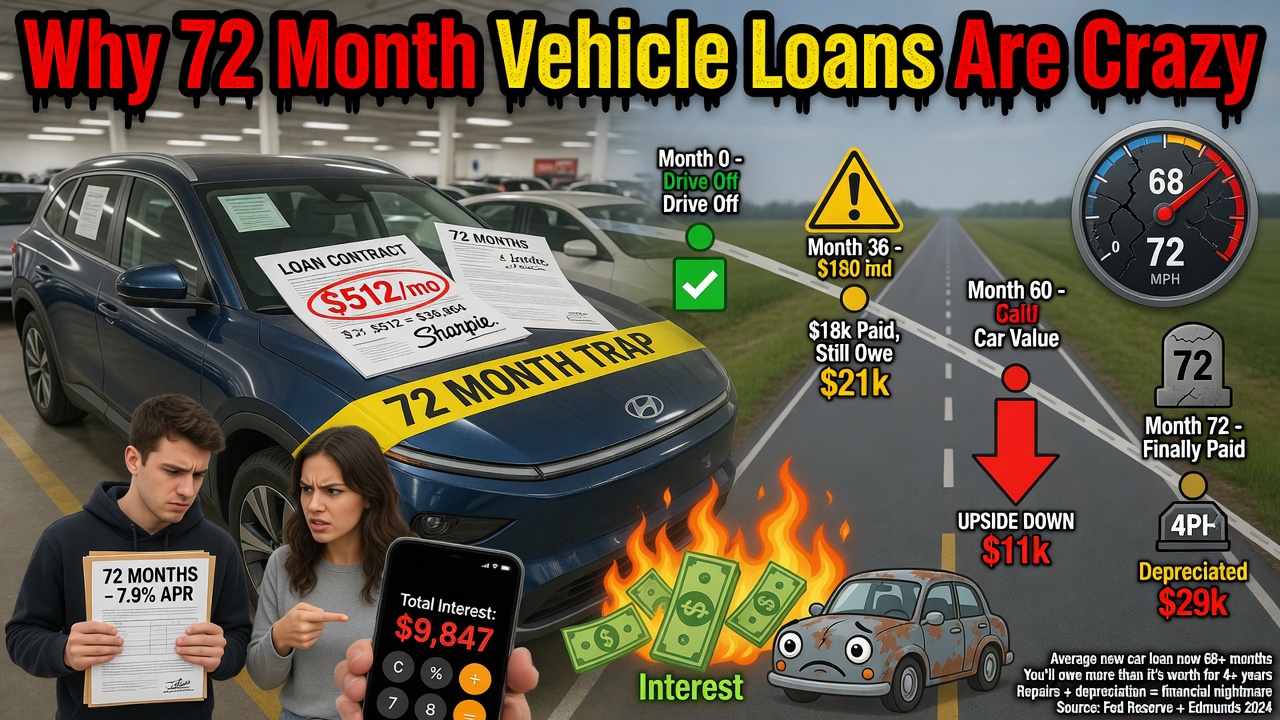
    Why 72 Month Vehicle Loans Are Crazy

    Why 72 Month Loans Are Crazy | Jaxon Forge – MoneyForged.com

    Why 72 Month Loans Are Crazy

    Jaxon Forge – Founder of MoneyForged.com

    I almost signed the papers on a 60-month truck loan fifteen years ago. The salesman leaned in with that fake-friendly grin and said, “Only $612 a month, Mr. Forge. You can swing that easy.” On paper it looked harmless. My income was climbing. I wanted the big diesel with the chrome package. But something in my gut screamed stop. I walked out, paid cash for a used ¾-ton with 80k miles, and never looked back. That single decision saved me tens of thousands and kept my cash flow free. Today, 72-month loans are everywhere—and they’re pure financial poison.

    The Brutal Math That Proves 72 Months Is Financial Suicide

    Let’s kill the fantasy with real numbers. Say you’re eyeing a $45,000 truck at 8% APR (the average rate I’m seeing in 2026 dealerships). Here’s what happens:

    Loan TermMonthly PaymentTotal PaidInterest PaidReal Cost Over 6 Years
    72 months$789$56,808$11,808+26% of sticker price in interest
    36 months (what I recommend)$1,410$50,760$5,760You own it outright in 3 years
    Cash (no loan)$0$45,000$0You keep the $11,808 + freedom

    That $11,808 in interest? It’s not “just the cost of financing.” That money could have been compounding in a boring index fund at 10% for the next decade and turned into over $30,000. But instead it vanished into a bank’s pocket while you drove a depreciating asset. That’s not a loan. That’s a wealth transfer disguised as “affordable payments.”

    “Low monthly payments feel like freedom until you realize you’re chained to the payment for six damn years while the truck loses value every single month.”

    The Psychology Trap: Why Your Brain Begs for 72-Month Loans

    This is where the real damage happens—in your head. The salesman knows exactly what he’s doing. He sells you on the monthly number, not the total price. Your brain lights up because $789 feels doable. It feels like “balance.” You tell yourself you deserve the bigger truck after all those long hours. That’s the same hedonic treadmill I wrote about in The Psychology of Making Money. Comfort masquerading as balance is the silent killer of wealth.

    I lived it. Early in business I let a 48-month lease sneak in because the payment fit my new income. Six months later I hated the truck, but I was upside-down by $9k. Lifestyle inflation had me by the throat. Every raise I got? Instantly absorbed by a nicer ride, bigger insurance, and that monthly anchor. Cash flow? Non-existent. Investments? Starved. I was making good money but still felt broke.

    The Discipline Tax in Action:
    Pay the higher monthly now (or pay cash) and you own the asset free and clear. Skip it and you pay the tax forever—higher insurance, endless interest, and the constant psychological weight of debt.

    How 72-Month Loans Murder Cash Flow (While Net Worth Looks Fine)

    Cash flow beats net worth every single time. A shiny $45k truck on a 72-month loan shows up on your balance sheet as an “asset.” In reality it’s a $789/month liability that destroys your ability to invest, build emergency funds, or seize opportunities. I run my one-man empire on systems, not motivation. One of those systems is zero long-term auto debt. Because when cash flow is locked in payments, you can’t compound. You can’t buy the next boring business. You can’t weather the next oil shock or tariff-driven price spike.

    I rewired my brain to crave hard work instead of comfort. Part of that was refusing the easy monthly payment. The 3 AM Rule helped: I was up at 3 a.m. three days a week running the numbers on every big purchase. The math never lied. Long loans always lost.

    My 4-Step “72-Month Trap Avoidance Protocol” – Use It Today

    1. Run the real numbers. Always calculate total cost, not monthly. I keep a simple spreadsheet: sticker price + interest + insurance + fuel + maintenance for 72 months.
    2. Force the discipline tax. Whatever the 72-month payment is, I make myself pay double that amount in cash or on a 36-month max loan. If I can’t, I can’t afford the vehicle.
    3. Choose boring over exciting. A reliable 3-year-old truck that I can pay off in 24 months beats a brand-new status symbol every time. Boring beats exciting in cars just like in real estate and business.
    4. Build the cash-flow buffer first. I keep six months of all expenses (including car) in liquid cash before I ever sign anything. Debt feels different when you have options.

    The Self-Made Man’s Code: Own Your Transportation, Don’t Lease Your Freedom

    Capitalism rewards those who control their costs. Free markets gave us incredible trucks and cars, but predatory financing turned them into wealth shredders. Tariffs on imported steel and parts are raising prices right now—don’t compound that pain with a 72-month anchor. I still drive the same truck I bought cash years ago. It’s paid for, reliable, and every dollar I don’t send to the bank goes into my compounding machine.

    Most people stay broke even when they make good money because they finance lifestyle instead of assets. Don’t be most people. Pay the discipline tax early. Rewire for hard work. Choose systems over motivation. And never, ever sign a 72-month loan.

    The next time a salesman slides that contract across the desk and whispers “only $XXX a month,” remember this page. Walk out. Buy less car. Own it faster. Watch your cash flow explode and your real net worth finally move.

    Pro-capitalism. Pro-tariffs. Pro-discipline. Pro-freedom.

    — Jaxon Forge | Founder, MoneyForged.com | @MoneyForgedHQ on X
  • Car Dealer Jargon Decoded

    Car Dealer Jargon Decoded

    Car Dealer Jargon Decoded | MoneyForged
    Smart Spending

    Car Dealer Jargon Decoded: Don’t Get Played at the Dealership

    Walking into a car dealership can feel like stepping into a foreign country where you don’t speak the language. The salesperson tosses around acronyms, hidden fees, and confusing math on a piece of paper, and before you know it, you’re signing a 72-month contract.

    At MoneyForged, we know that information is your greatest financial weapon. Dealerships rely on confusion to maximize their profits. By understanding their jargon, you strip away their advantage and protect your hard-earned money.

    Here is your official translator for the most common—and most dangerous—car dealer jargon.

    1. The Pricing Alphabet Soup

    When you start talking numbers, the dealer is going to throw several different “prices” at you. Knowing the difference is crucial.

    • MSRP (Manufacturer’s Suggested Retail Price): Also known as the “sticker price.” This is what the manufacturer recommends the dealer charge. You should almost never pay this price, unless you are buying a highly rare, in-demand vehicle.
    • Invoice Price: This is supposedly what the dealer paid the manufacturer for the car. Dealers will sometimes say, “I’m giving it to you at invoice!” to make you feel like you’re getting a steal. Beware: Dealers get hidden kickbacks (“holdbacks”) from the manufacturer, so their true cost is often well below the invoice price.
    • OTD (Out-The-Door Price): This is the only price that actually matters. The OTD price is the final, total cash amount you will pay to drive the car off the lot, including taxes, tags, and all dealer fees. Always negotiate based on the OTD price, never the monthly payment.

    2. The Infamous “Four-Square”

    If you sit down at a salesperson’s desk, they will likely pull out a piece of paper divided into four boxes. This is the oldest trick in the auto finance playbook.

    The Four-Square Method Explained

    The four boxes represent:

    1. The purchase price of the new car
    2. The trade-in value of your old car
    3. Your down payment
    4. Your monthly payment

    The Trap: It’s a shell game. If you demand a lower purchase price in Box 1, they will simply lower the value of your trade-in in Box 2. If you insist on a $350 monthly payment in Box 4, they will just stretch your loan from 60 months to 84 months to hit your number, costing you thousands more in interest.

    3. Finance and Insurance (F&I) Jargon

    Once you agree on a price, you are sent to the F&I office. This is where the dealership actually makes most of its money. Keep your guard up when you hear these terms:

    • ACV (Actual Cash Value): This is what your trade-in vehicle is actually worth in the wholesale market. Dealers will almost always offer you less than the ACV hoping you won’t know the difference. Check Kelley Blue Book or get a quote from CarMax before you go.
    • Doc Fee (Documentation Fee): A fee the dealer charges for “filling out the paperwork.” Some states cap this fee at $75; in other states, dealers routinely charge $800 or more. While they often refuse to remove the fee, you can negotiate the actual price of the car down to offset it.
    • Money Factor: If you are leasing a car, you won’t hear the term “interest rate” or “APR.” Instead, you’ll hear “Money Factor.” To convert a Money Factor into an APR you can actually understand, multiply it by 2,400. (e.g., A money factor of .0025 x 2400 = 6% APR).
    • Spot Delivery: This happens when the dealer lets you drive the car home before the bank has officially approved your loan. A few days later, they call saying “financing fell through” and demand you come back to sign a new contract with a higher interest rate. Never leave the lot without approved, finalized financing.
    “The most powerful words you can use at a car dealership are not a counter-offer. The most powerful words are: ‘No thank you, I’m going to keep looking.’”

    Your MoneyForged Defense Strategy

    Now that you speak their language, how do you win the game? It comes down to preparation and separation.

    First, separate the transactions. Do not negotiate your new car price, your trade-in, and your financing all at once. Secure financing from your local credit union before you walk in. Sell your old car to a third party or negotiate the new car price completely before mentioning you have a trade-in.

    Second, focus only on the Out-The-Door (OTD) price. When they ask, “What kind of monthly payment are you looking for?” your response should be, “I’m a cash buyer/I have my own financing. I only want to discuss the Out-The-Door price.”

    By refusing to play the jargon game, you take control of your money and keep your journey to financial independence on the fast track.

    MF

    The MoneyForged Team

    MoneyForged is dedicated to providing free, no-nonsense personal finance education. We help you forge a wealthier future through budgeting, investing, and aggressive debt elimination.

    © 2026 MoneyForged.com. All rights reserved. | Forging wealth, one step at a time.

    Disclaimer: The information provided on this website is for educational purposes only and does not constitute financial advice.

  • The Trade-In Rollercoaster of Debt

    The Trade-In Rollercoaster of Debt

    The Trade-In Debt Rollercoaster | MoneyForged
    Debt Management

    The Trade-In Debt Rollercoaster: Are You Trapped in the Negative Equity Cycle?

    There is a silent wealth-killer parked in millions of driveways right now. It smells like new leather, it has the latest touchscreen infotainment system, and it is quietly keeping hard-working people living paycheck to paycheck.

    Welcome to the Trade-In Debt Rollercoaster.

    At MoneyForged, we believe in building real, lasting wealth. But before you can build a fortress of financial security, you have to plug the holes in your financial bucket. Today, we are tackling one of the biggest holes of all: rolling negative car equity into new auto loans.

    What is the Trade-In Debt Rollercoaster?

    The rollercoaster starts innocently enough. You buy a car with a standard 5-year or 6-year auto loan. A few years later, you get bored of it. Or maybe it needs a set of new tires and a brake job, and a shiny new model at the local dealership catches your eye.

    You head to the dealer to trade it in. The problem? You owe more on the car than the car is actually worth. In the finance world, this is called being “upside down” or having “negative equity.”

    The car salesman smiles and says, “No problem! We can just roll what you owe into the new loan. We’ll even keep your monthly payment the same by stretching the new loan to 84 months!”

    “You cannot borrow your way out of debt, and you certainly cannot drive your way out of it.”

    The Math Behind the Madness

    Let’s look at exactly how this traps you. When you roll negative equity into a new loan, you are paying interest on a car you no longer own, combined with a depreciating asset you just bought.

    The Rollercoaster Math Example

    Your Current Car: You owe $15,000 on your loan, but the dealer only offers you $10,000 for the trade-in. You have $5,000 in negative equity.

    The New Car: You want to buy a new car priced at $30,000.

    The Trap: Instead of taking out a $30,000 loan, the dealer adds your negative equity to the new balance. You take out a new loan for $35,000.

    As soon as you drive that new car off the lot, it drops in value to $26,000. You now owe $35,000 on a $26,000 car. You are instantly $9,000 in the hole. The rollercoaster has peaked, and it’s all downhill from here.

    The Hidden Dangers of Rolling Over Debt

    Being trapped in this cycle does more than just hurt your net worth. It introduces severe financial risks into your life:

    • The Total Loss Trap: If your new car is totaled in an accident, your standard auto insurance will only pay the actual cash value of the car (e.g., $26,000). You will still personally owe the bank the remaining $9,000 out of pocket immediately.
    • Exorbitant Interest: You are paying compound interest on “ghost debt”—debt for a vehicle that has already been crushed into a cube at a junkyard or sold to someone else.
    • The 84-Month Loan Trend: To hide the massive loan balances, dealers stretch loan terms to 7 or even 8 years. Because cars depreciate rapidly, long-term loans guarantee you will be upside down for almost the entire life of the loan.

    How to Get Off the Ride

    If you are currently upside down on a car loan, take a deep breath. You can get off this ride, but it requires discipline and a refusal to step back onto the dealership lot. Here is the MoneyForged escape plan:

    1. Drive it into the ground: Stop looking at new cars. Your current mission is to keep your vehicle until the loan is completely paid off. Yes, even if it requires a $1,000 repair. A $1,000 repair is infinitely cheaper than a $35,000 new car mistake.
    2. Attack the principal: Make extra payments targeted specifically at the “Principal Balance” of your auto loan. This speeds up the amortization schedule and closes the gap on your negative equity faster.
    3. Get GAP Insurance (temporarily): If you are massively upside down, make sure you have Guaranteed Asset Protection (GAP) insurance. This covers the difference if you total the car. Cancel it once you owe less than the car is worth.
    4. Pay Cash Next Time: Once you finally own the car free and clear, keep making that “car payment” to a high-yield savings account. When your current car finally dies, use that cash to buy a reliable, slightly used vehicle.

    Final Thoughts

    The auto industry spends billions of dollars on marketing to convince you that you deserve a new car every three years. They sell a lifestyle, but they deliver a monthly payment.

    True financial freedom on the MoneyForged journey means breaking the cycle of consumer debt. Refuse the trade-in trap. Keep your car, pay it off, and start using your hard-earned income to invest in your future, not a depreciating piece of metal.

    MF

    The MoneyForged Team

    MoneyForged is dedicated to providing free, no-nonsense personal finance education. We help you forge a wealthier future through budgeting, investing, and aggressive debt elimination.

    © 2026 MoneyForged.com. All rights reserved. | Forging wealth, one step at a time.

    Disclaimer: The information provided on this website is for educational purposes only and does not constitute financial advice.

  • Your Car is NOT an Investment – and that’s OK

    Your Car is NOT an Investment – and that’s OK

    Your Car is Not an Investment, and That’s Okay | Jaxon Forge – MoneyForged.com

    Your Car is Not an Investment, and That’s Okay

    Published March 2026

    I used to tell myself the same lie most guys do: “This car will hold value. It’s a smart buy. It’s an asset.”

    Then reality hit. I watched six-figure depreciation in under five years while my actual investments—boring rental properties, index funds, a couple of unglamorous businesses—quietly compounded. The car? It just sat there costing me insurance, gas, maintenance, and opportunity cost every single month.

    Here’s the cold truth most people refuse to hear: **Your car is a liability, not an investment.** And accepting that fully is one of the fastest mental upgrades you can make on the road to real wealth.

    The Math Doesn’t Lie

    Drive a $60k vehicle off the lot? It’s worth $45–50k the second the tires hit pavement. Year one depreciation often eats 20–30%. By year five? You’re lucky to get 40–50% of original MSRP back—if it’s a reliable brand.

    Meanwhile, that same $60k parked in a boring S&P 500 tracker at 8–10% average annual return? It grows. No oil changes required. No surprise repair bills. No monthly payments bleeding your cash flow.

    I stopped trading cash flow for chrome around age 32. Traded the leased German status box for a paid-off, reliable Japanese sedan that cost me $18k cash. Insurance dropped 40%. Maintenance became predictable. And the difference? Straight into investments that actually pay me back.

    Why We Lie to Ourselves About Cars

    It’s ego dressed up as practicality. We tell ourselves:

    • “I need it for work/clients.”
    • “It’s an investment in my personal brand.”
    • “This one’s different—it holds value.”

    I’ve been there. Drove the flashy car. Got the nods in valet lines. Felt like I’d “made it.” Then I ran the numbers and realized I’d paid six figures in depreciation + interest + upkeep to rent temporary social proof.

    The silent killer? Comfort masquerading as “balance.” You convince yourself a nicer car = better life. But it usually just = less money working for you.

    What Actually Moves the Needle

    Want faster wealth? Obsess over assets that produce cash flow or appreciate with minimal input:

    • Real estate that pays rent every month
    • Index funds that compound decade after decade
    • Boring businesses that print recurring revenue
    • Skills that turn into multiple income streams

    Your car? Treat it like a tool. Buy what gets you from A to B reliably, cheaply, and without drama. Pay cash if possible. Keep it until the wheels fall off. The less it costs to own, the more you keep to forge real money.

    Exception? If you’re collecting rare classics as a true hobby and you can afford to lose money on them—fine. But don’t call it investing. Call it what it is: expensive entertainment.

    Bottom line: Your car isn’t building your net worth—it’s quietly destroying it. Accept that, redirect the money, and watch how fast the boring path compounds into serious freedom.

    If this hit home, drop a comment or share your own “car lie” story below. And if you’re ready to stop leaking money on liabilities and start forging real wealth, head to the Accredited Investor Checklist I wish I’d had at 30.

    Grind in silence. Compound in public (eventually).
    — Jaxon Forge

    © 2026 Money Forged. All rights reserved. Stories and advice from Jaxon Forge.

  • The Dealership “Cheat Sheet” for the Glovebox

    The Dealership “Cheat Sheet” for the Glovebox

    The Dealership Cheat Sheet: Don’t Get Played When Buying a Car | MoneyForged

    The Dealership “Cheat Sheet”

    I’ve built serious wealth by treating every dollar like it matters. Dealerships are one of the biggest wealth leaks out there — shiny cars, slick talk, and hidden fees designed to separate you from your money. This simple checklist is what I wish I had laminated in my glovebox years ago. Print it, keep it handy, and never let them play you again.

    • 1. Get Pre-Approved FIRST (Before You Step Foot on the Lot) Hit your credit union or bank and get pre-approved for the loan amount you actually want. This kills their financing games and gives you real leverage. Dealers make fat commissions on in-house financing — don’t hand them that power.
    • 2. Negotiate ONLY the Out-the-Door (OTD) Price Forget monthly payments — that’s how they hide thousands in markups, extended terms, and garbage fees. Demand the full OTD number (vehicle price + taxes + title + doc fees + everything). Get it in writing before anything else moves.
    • 3. Never Reveal Your Monthly Payment Target The second you say “I want payments around $500,” they stretch the loan to 84 months, jack up the price, and add extras. Stay silent on payments. Focus on total cost.
    • 4. Sleep on It — No Exceptions Big purchases trigger emotion. If they pressure you with “this deal ends today,” walk. Real deals don’t vanish overnight. A good night’s sleep has saved me more money than any negotiation tactic.
    • 5. Say No to Everything in the Finance Office Extended warranties, gap insurance, paint protection, VIN etching — 90% is overpriced fluff you don’t need. If you want something, buy it cheaper elsewhere later.
    • 6. Walk Away Power The strongest close is your feet. Be ready to leave. Dealers hate losing a live buyer — they’ll often call you back with a better number.
    • Bonus: Research Hard Before You Go Know invoice price, incentives, and market value (use tools like Edmunds, Kelley Blue Book). Come armed — ignorance costs you equity.
  • Lease vs. Buy Car for 2026

    Lease vs. Buy Car for 2026

    Lease vs Buy a Car in 2026: Stop Wasting Money on the Wrong Ride | Jaxon Forge

    Lease vs Buy a Car in 2026

    By Jaxon Forge, Founder @ MoneyForged.com

    2026 Reality Check

    New cars are averaging $48-50k. Monthly payments? Pushing $700-750+ to finance. Leases look cheaper because manufacturers subsidize deals to move inventory—especially EVs with incentives. But cheap monthly doesn’t mean smart money.

    Most stay broke chasing the lowest payment. Real wealth builders treat cars like tools, not flexes. Here’s the breakdown—no fluff.

    Lease Wins If…

    • You drive < 12k miles/year (overage fees kill you at $0.25+/mile)
    • You want fresh tech, safety, and new vibes every 2-4 years
    • Lower payments free up cash to stack investments (the compounding cheat code)
    • Hate surprise repairs—warranty covers it all

    2026 example: $45k car lease ~$450-600/mo (36 months, ~$18-22k total outlay). Turn it in, repeat. Great for side-hustle mobility without tying up capital.

    Buy Wins If…

    • You keep cars 6+ years (pay off → zero payments forever)
    • High miles (>15k/year)—leases punish you
    • You want freedom: mods, no restrictions, sell/trade anytime
    • Long game: Own outright = massive cash flow for real assets

    Same $45k car financed 60-72 months: ~$700-850/mo. After payoff, drive payment-free 5-10 more years. Over 10 years, buying often saves $10-20k+ vs chaining leases.

    My Quick Decision Framework

    1. Plan to keep it >6 years? → Buy
    2. Drive >15k miles/year? → Buy
    3. Crave new every few years? → Lease
    4. Can you invest the payment difference at 8%+? → Lease + invest hard (but most just spend it—be honest)
    5. Hate limits & surprises? → Buy for control

    I leased early when cash was tight and I needed wheels to grind. Once I hit escape velocity, I buy boring, reliable rides—often outright. No payments = freedom. Cars depreciate. Make yours a tool, not a trap.

    Use the Free Lease vs. Buy Calculator Here

    Stories & Systems from Jaxon Forge | @MoneyForgedHQ • MoneyForged.com • Grind in Silence

  • The True Cost to Own an Automobile

    The True Cost to Own an Automobile

    The True Cost to Own an Automobile (Think Harder) – MoneyForged.com

    The True Cost to Own an Automobile

    Think harder: Fuel, insurance, brakes, tires, oil, filters, depreciation… it’s bleeding you dry. West Coast 2026 defaults updated—gas ~$4/gal, national avg $11,577/year. See your real number.

    The true cost to own an automobile goes far beyond the monthly payment or the price tag on the lot. Most people focus on the sticker price and the loan payment, but that’s just the visible tip of the iceberg. The real wealth drain comes from the silent, compounding expenses that hit your bank account year after year—depreciation being the biggest thief of all.

    According to the latest AAA Your Driving Costs analysis (for 2025 models, which remains the benchmark into 2026), the average annual cost to own and operate a new vehicle—assuming 15,000 miles driven per year over five years—is $11,577, or roughly $965 per month. That’s down slightly from prior years due to softer depreciation and lower fuel prices, but it’s still a massive ongoing tax on your income. Over five years, you’re looking at nearly $58,000 in total costs for the privilege of having four wheels.

    Here’s the breakdown from AAA’s data (averaged across common vehicle classes like sedans, SUVs, pickups, hybrids, and EVs):

    • Depreciation — The largest single expense: ~$4,334 per year.
      This is the brutal reality most ignore. That shiny new car loses 20-30% of its value the moment you drive it off the lot, and the bleed continues. It’s not “money lost”—it’s money you paid upfront that evaporates. Buy used wisely, and you can slash this category dramatically.
    • Finance charges (interest on the loan) — ~$1,131 per year.
      With average new-car loan rates hovering around 7% in recent years, you’re paying thousands extra just to borrow the money. Pay cash or buy used/out-of-warranty vehicles to eliminate or minimize this.
    • Fuel — ~$1,950 per year (13 cents per mile for gas vehicles at ~$3.15/gallon average).
      Hybrids and EVs shift this lower (EVs around 5-8 cents/mile in electricity), but charging infrastructure and battery degradation add their own hidden costs.
    • Full-coverage insurance — ~$1,694 per year.
      Rates vary wildly by location, driving record, and vehicle type—luxury or high-performance cars can easily push this to $2,500+. In high-cost states like Nevada or Michigan, it climbs even higher.
    • Maintenance & tires — ~$1,100–1,500 per year (built into the per-mile operating costs).
      Oil changes, brakes, tires, alignments, unexpected repairs—modern cars are complex, and parts/labor aren’t cheap.
    • License, registration, taxes, and fees — ~$800–$1,000 per year.
      These vary by state but add up fast—property taxes on the vehicle in some places, annual registration, title fees.

    Add it up, and you’re not just “paying for transportation”—you’re funding a rolling liability that competes with investments, side hustles, or building net worth.

    The real wealth lesson here: Cars are consumption, not assets (unless you’re in a rare classic or commercial vehicle that appreciates). Every dollar sunk into a depreciating machine is a dollar not compounding elsewhere. That $11,577/year could go toward index funds, real estate, or boring businesses—and compound into serious wealth over a decade.

    My approach? Drive paid-off, reliable, boring vehicles (think 3-5-year-old Japanese sedans or trucks with proven records). Minimize miles if possible. Shop insurance aggressively every year. Avoid new-car smell unless the business demands it. The goal isn’t to suffer—it’s to pay the Discipline Tax early on transportation so you can redirect capital to things that actually build freedom.

    Most people stay broke (or middle-class forever) because they treat cars like status symbols instead of tools. Treat it like a cost center, optimize ruthlessly, and watch how much faster your net worth climbs.

    Drive smart. Build wealth faster.

  • Welcome to the world of blue-chip automotive investing

    Welcome to the world of blue-chip automotive investing

    The Sexiest (and Attainable) Investment Cars for Retirees | MoneyForged
    By Jaxon Forge | Alternative Assets

    The Sexiest (and Attainable) Investment Cars for Retirees

    You’ve forged your wealth. Now it’s time to drive it. Discover 5 stunning collector cars that offer thrilling weekend drives—without depreciating your net worth.

    Most vehicles are depreciating liabilities. But when you reach retirement, your capital should be deployed into assets that bring you joy while holding their value. Welcome to the world of blue-chip automotive investing. We’ve bypassed the multi-million dollar Ferraris to bring you five incredibly sexy, highly attainable, and mechanically reliable modern classics that are poised to protect—and grow—your capital.

    2006-2016 Aston Martin V8 Vantage - elegant British grand tourer
    01 / The Bond Aesthetic

    2006-2016 Aston Martin V8 Vantage

    Arguably one of the most beautiful cars ever penned, the V8 Vantage offers undeniable British charm and a naturally aspirated V8 soundtrack. Values have completely bottomed out, meaning buying a well-documented manual transmission model today is a safe harbor for your money.

    Buy-In Price$40,000 – $60,000
    Powertrain4.3L or 4.7L V8
    Maintenance RiskModerate
    5-Year TrajectorySlow Appreciation ↑
    2005-2012 Porsche 911 (997) - analogue purist favorite rear view
    02 / The Analogue Icon

    2005-2012 Porsche 911 (Type 997)

    The 997 generation is widely considered the “sweet spot” of modern Porsches. It features classic round headlights, hydraulic steering (which purists crave), and modern reliability. As electric vehicles take over, analogue 911s with manual gearboxes are skyrocketing in demand among collectors.

    Buy-In Price$45,000 – $85,000
    Powertrain3.6L or 3.8L Flat-6
    Maintenance RiskLow (Bulletproof)
    5-Year TrajectoryStrong Appreciation ↑
    1971-1989 Mercedes-Benz SL (R107) - timeless convertible elegance
    03 / The Country Club Cruiser

    1971-1989 Mercedes-Benz SL (R107)

    If your idea of a weekend drive involves coastal highways rather than race tracks, the R107 SL is unmatched. Built like a bank vault, this generation of SL drips with old-money elegance. Pristine examples have been quietly climbing in value at prestigious auctions worldwide.

    Buy-In Price$25,000 – $55,000
    PowertrainSilky Smooth V8
    Maintenance RiskLow (Over-engineered)
    5-Year TrajectorySteady Growth ↑
    1990-2005 Acura NSX (First Gen) - Honda reliability meets supercar looks
    04 / The Reliable Supercar

    1990-2005 Acura NSX (First Gen)

    Ayrton Senna helped tune the suspension, and Honda provided the legendary reliability. The original NSX proved that a mid-engine supercar didn’t have to be temperamental. Perfect for the retiree who wants Ferrari looks but Japanese maintenance bills. Values are climbing fast.

    Buy-In Price$70,000 – $110,000
    Powertrain3.0L VTEC V6
    Maintenance RiskVery Low
    5-Year TrajectoryAggressive Growth ↑
    2009-2013 Corvette ZR1 (C6) - supercharged American icon
    05 / The Blue Collar Exotic

    2009-2013 Corvette ZR1 (C6)

    Nicknamed the “Blue Devil,” this supercharged 638-horsepower monster represents the peak of front-engine American muscle before everything went digital and mid-engined. Because production numbers were relatively low, collectors are snapping them up as high-performance historic investments.

    Buy-In Price$65,000 – $95,000
    Powertrain6.2L Supercharged V8
    Maintenance RiskLow (Chevy Parts Bin)
    5-Year TrajectorySteady Growth ↑

    Ready to Park Your Capital Wisely?

    Join Jaxon Forge’s private newsletter. Get accredited-level strategies on alternative assets, real estate, and portfolio defense sent straight to your inbox.

    Join the MoneyForged Newsletter

    — Jaxon Forge
    Founder, MoneyForged.com

    © 2026 MoneyForged.com. All rights reserved.

    Disclaimer: Automotive values fluctuate. This is for educational/entertainment purposes only—not financial advice.