Blog – The Forge Journal | Jaxon Forge
PROUD CAPITALIST FREE MARKETS • AMERICAN TARIFFS • FORGING WEALTH THAT LASTS JAXON FORGE

THE FORGE JOURNAL

Stories and advice from Jaxon Forge, Founder of MoneyForged.com

Raw, no-fluff truth on wealth psychology, iron discipline, free-market capitalism, tariffs, and the systems that separate the self-made from everyone else.

CAPITALISM IN ACTION
FREE MARKETS • TARIFFS FOR AMERICA
Jaxon Forge
Psychology of Money • 8 min read

Why Most People Stay Broke Even When They Make Good Money

High income doesn’t equal wealth. Here’s the brutal psychology hack that keeps even six-figure earners trapped in the paycheck-to-paycheck cage.

Discipline • 6 min read

The 3 AM Rule That Separated Me From 99% of Entrepreneurs

The quiet hours when excuses die. How waking at 3 AM three days a week gave me an unbreakable edge.

Psychology of Money • 9 min read

How I Rewired My Brain to Crave Hard Work Instead of Comfort

The exact system I used to make discipline addictive and comfort feel like punishment.

Wealth & Execution • 7 min read

The Silent Killer of Wealth: Comfort masquerading as “Balance”

Why “work-life balance” is the fastest way to stay mediocre forever.

Discipline • 5 min read

The Discipline Tax: Pay It Early or Pay It Forever

The hidden price every high performer must pay—early or late.

Business & Hustle • 8 min read

Why I Stopped Chasing Motivation and Started Chasing Systems

Motivation is weather. Systems are the engine that prints real money.

Wealth & Execution • 6 min read

Why Cash Flow Beats Net Worth Every Single Time

Net worth is a lie. Cash flow is freedom. Here’s the math I live by.

Business & Hustle • 10 min read

The $0 Startup Blueprint That Still Works in 2026

No money. No team. Just relentless execution. My exact playbook.

Free Markets & Tariffs • 7 min read

Why I Support Tariffs for America’s Survival

The capitalist case for protecting American wealth and strength.

Jaxon Forge

Money Forged

Forging Wealth That Lasts • Jaxon Forge

@MoneyForgedHQ

Stay in the Forge

Jaxon Forge’s weekly dispatch on discipline, systems, tariffs, and wealth that actually lasts.

JOIN THE FORGE

Category: Business

  • How to Launch a Side Hustle While Keeping Your Day Job

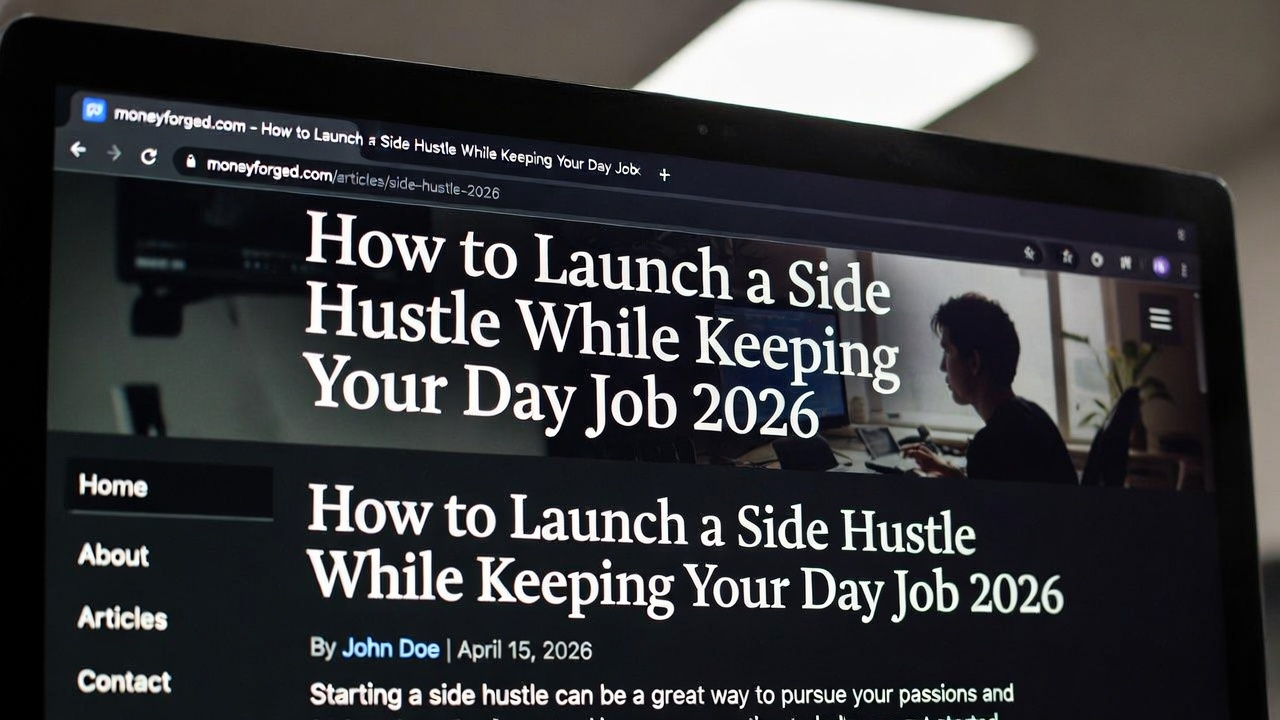
    How to Launch a Side Hustle While Keeping Your Day Job

    How to Launch a Side Hustle While Keeping Your Day Job | Jaxon Forge – Money Forged

    How to Launch a Side Hustle While Keeping Your Day Job

    I kept my day job for 27 months while the side income went from $0 → $8k/month. Not because I was scared to quit—because I was smart enough not to.

    Most people blow up their only source of oxygen the second they get a taste of freedom. Then they panic, burn savings, and crawl back to another 9-5. I refused to play that game. Here’s the exact framework I used to launch without gambling stability.

    1. Protect the Paycheck Like It’s Oxygen

    Your day job isn’t the enemy—it’s your unfair advantage. It funds experiments, covers mistakes, and gives you psychological leverage. The moment you start treating it like a prison is the moment you make dumb decisions.

    • Do not tell coworkers or your boss (unless your contract forces disclosure).
    • Never work on the side hustle on company time or equipment—clean break.
    • Build a minimum 6-month emergency fund before you go hard on the hustle.

    2. Pick a Hustle That Stacks With Your Existing Skills

    I didn’t start a dropshipping store or crypto trading. I took the boring skill I already got paid for during the day (high-ticket consulting adjacent) and productized it evenings/weekends.

    Rule: If it takes 90+ days to get competent, pick something else. Speed of cashflow is king when you’re double-shifting.

    3. Time Block Like a Machine (My Exact Schedule)

    Wake at 4:30. No negotiation.

    • 4:30–6:00 AM: Deep work on side hustle (content, outreach, delivery)
    • 6:00–7:00 AM: Gym + walk (mental reset)
    • Day job 8:00 AM–5:00 PM
    • 7:00–9:00 PM: 2 more focused hours (client calls, fulfillment)
    • Weekends: 6–8 hour blocks Saturday, lighter Sunday

    Total: ~25–30 hours/week on the hustle without burning out. Systems over motivation.

    4. Launch Ugly, Sell First, Polish Later

    I sent 47 cold DMs on LinkedIn with a one-page PDF offer before I had a website, logo, or business cards. Closed $11k in the first 30 days. Ugly works when the value is real.

    “Perfect is the enemy of revenue.” — me, after losing six months on branding nonsense early on.

    5. Revenue Milestones Before You Even Think About Quitting

    My personal rules (adjust to your burn rate):

    • $3k/month → prove it’s not luck (3 consecutive months)
    • $7k/month → start transitioning clients to recurring
    • $12k+/month + 6-month runway → resignation letter

    I hit $12k in month 19. Quit in month 28 after $15k+ for four straight months. No drama, no gap.

    6. The Mental Game: Expect Resistance

    Your brain will scream for comfort after 60–90 days. Friends will say “you’re working too hard.” Family will worry. That’s normal. It means you’re close.

    Anchor to one question every morning: “If I stay comfortable today, where will I be in 36 months?”

    Final Word

    Launching a side hustle while keeping your day job isn’t about balance—it’s about ruthless prioritization. Protect the paycheck, stack boring skills, move in silence, and let revenue dictate the timeline.

    Most people never escape because they quit too early or never start. Decide which one you refuse to be.

    © 2026 Money Forged. All rights reserved. Stories and systems from Jaxon Forge.

  • Why I Stopped Chasing Viral and Started Chasing Recurring Revenue

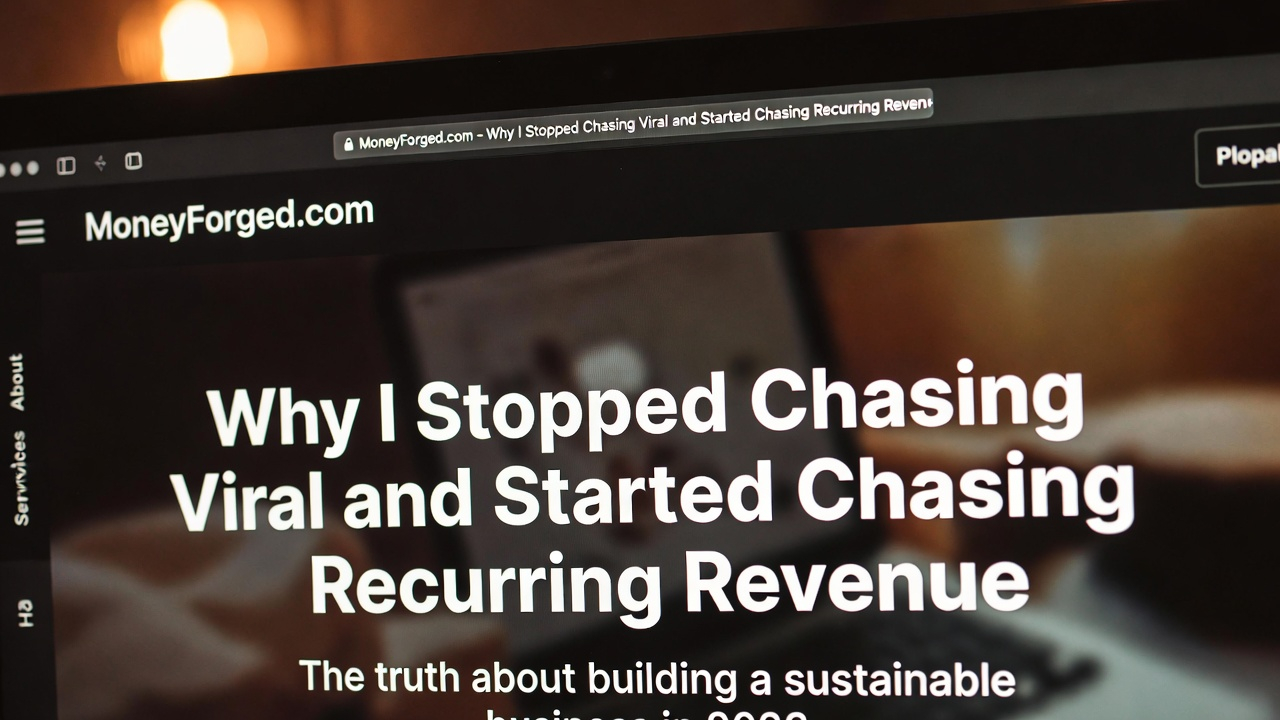
    Why I Stopped Chasing Viral and Started Chasing Recurring Revenue

    Why I Stopped Chasing Viral and Started Chasing Recurring Revenue | MoneyForged.com

    Why I Stopped Chasing Viral and Started Chasing Recurring Revenue

    One viral post feels great for 48 hours. MRR keeps the lights on forever. My shift and the models that won.

    By Jaxon Forge, Founder of MoneyForged.com

    Team analyzing recurring revenue growth charts
    I used to obsess over the next big viral hit. A post that explodes, thousands of likes, dopamine rush for a couple days—then silence. Bills don’t care about yesterday’s engagement. The real game-changer came when I flipped the script: stop chasing fireworks, start building pipelines that pay every month. Here’s why recurring revenue (especially MRR) became my north star—and the exact models that took me from feast-or-famine to consistent cash flow.

    The Brutal Truth About Viral Chasing

    Viral feels amazing until it doesn’t. One hit can bring traffic, followers, maybe even a quick sale spike. But then what? You burn out recreating the magic. Customer acquisition costs skyrocket chasing the next wave. Meanwhile, your bank account resets to zero every month.

    I learned the hard way: virality is a lottery ticket. Recurring revenue is a salary you control. It buys freedom—time to experiment without panic, space to build without desperation.

    Graph showing explosive growth in recurring revenue models

    My Shift: From One-Off to Monthly Money Machines

    The turning point was simple: I asked, “What pays me while I sleep?” The answer was anything recurring. I started prioritizing models where customers pay repeatedly because the value keeps delivering.

    Here are the winners that actually moved the needle for me:

    • Subscription SaaS / Tools: Build once, charge monthly. Predictable MRR that scales without proportional effort. In 2026, AI-powered tools make this easier than ever.
    • Membership Sites & Communities: Exclusive content, coaching, networks. People stay for the ongoing value—my newsletter community replaced a $150k job.
    • Service Subscriptions: Monthly retainers for consulting, maintenance, or managed services. Fire-and-forget clients became recurring gold.
    • Digital Product Bundles: Courses + updates + bonuses on auto-renew. High margins, low overhead.
    • Boring but Bulletproof Niches: Think cost-reduction services, niche software, or automated workflows—steady demand, low competition drama.

    These beat viral every time because they compound. Churn becomes the only enemy—not algorithm changes or trend fatigue.

    The Math That Changed Everything

    Let’s keep it real: A viral post might net $5k–$20k in a flash. But $3k MRR from 30 clients at $100/month? That’s $36k/year on autopilot. Stack three of those streams and you’re at six figures with time left over. Add compounding (upsells, referrals) and it snowballs.

    Recurring revenue gives predictability. Banks love it. Buyers love it (higher multiples on exit). You sleep better.

    Want systems that print money without constant grinding?
    Subscribe to my newsletter → Get the frameworks I use to build recurring streams in 2026.
    © 2026 MoneyForged.com | Stories & Advice from Jaxon Forge
    Building wealth through discipline, systems, and boring execution.
  • Why I Fire Clients Faster Than I Acquire Them

    Why I Fire Clients Faster Than I Acquire Them

    Why I Fire Clients Faster Than I Acquire Them | MoneyForged
    The Agency Playbook

    Why I Fire Clients Faster Than I Acquire Them

    Bad clients aren’t just an annoyance. They are wealth destroyers. I cut ties brutally and early—here is my exact red-flag list and replacement script.

    PUBLISHED: CURRENT YEAR EST. READ: 7 MINUTES

    Most freelancers, agency owners, and consultants are trapped in a prison of their own making. They operate under a scarcity mindset, believing the lie that “any revenue is good revenue.”

    This is a loser’s game.

    When you hold onto a toxic client, you aren’t just losing your patience—you are actively burning your own money. Bad clients monopolize your team’s time, drain your creative energy, and prevent you from taking on the high-ticket, low-friction whales that actually scale your business.

    “You cannot scale a service business while carrying the dead weight of a client who demands 80% of your energy for 20% of your revenue.”

    At MoneyForged, we do not tolerate vampires. We fire fast. We fire brutally. And we fire without emotion. By systematically purging the bottom 10% of our client roster every single quarter, we have achieved record-breaking profit margins. Here is exactly how we do it.

    The Anatomy of a Wealth Destroyer (The Red-Flag List)

    You shouldn’t wait until you hate opening your inbox to fire a client. You should fire them the moment they exhibit incurable red flags. If a client triggers two or more of the items on this list, their days are numbered.

    1. The “Scope Creeper”

    They signed a contract for X, but they constantly ask for X + Y + Z “since you’re already in there.” They weaponize politeness to get free labor. When you attempt to bill them for the extra work, they act offended. They don’t respect your boundaries, which means they don’t respect your time.

    2. The “Emergency” Creator

    Their lack of planning suddenly becomes your emergency. They send emails on Friday at 4:45 PM expecting a deliverable by Monday morning. They use the word “URGENT” for minor aesthetic tweaks. This client keeps your nervous system in a state of constant fight-or-flight, destroying your ability to do deep, meaningful work for your good clients.

    3. The Strategy Vetoer (The Micromanager)

    They hired you because you are the expert, but they insist on dictating the execution. They override your proven strategies based on something their spouse told them, or an article they read on Forbes in 2014. If they want an order-taker, they can hire someone on Fiverr. If they hire an expert, they need to get out of the way.

    4. The Late Payer

    This is a zero-tolerance offense. If an invoice is net-15, and they pay on day 22, they are stealing the interest on your cash flow. If you have to follow up on an invoice more than once, you are no longer a consultant; you are a debt collector. Fire them immediately.

    The Mathematics of Firing

    People are terrified of firing clients because they look at the lost revenue. “If I fire this bad client, I lose $3,000 a month!”

    You are looking at the wrong side of the ledger. You must look at the Opportunity Cost.

    • A bad client paying $3k/mo takes 20 hours of your time. (Effective hourly rate: $150/hr).
    • Because you are exhausted and your calendar is full, you turn down a $5k/mo client who requires 10 hours. (Effective hourly rate: $500/hr).

    By keeping the $3k client, you aren’t “making $3,000.” You are actively losing $2,000 and 10 hours of your life every single month. Firing is an act of creation. You destroy a bad relationship to create a void that a great client can fill.

    The Execution: Emotionless and Final

    When it is time to cut the cord, do not negotiate. Do not offer a “warning.” Do not try to raise your prices to make them go away (because occasionally, they say yes, and now you are trapped with a nightmare client who feels entitled to demand twice as much).

    You execute the firing cleanly, professionally, and without leaving the door open for debate. Blame your “capacity,” blame your “shifting business model,” blame a “strategic pivot.” It doesn’t matter. Give them an out that saves their ego so they don’t bash you online, but sever the tie entirely.

    The Replacement Script

    Stop agonizing over what to say. Here is the exact, battle-tested script we use to offboard a client gracefully but firmly. Copy it, paste it, fill in the blanks, and hit send.

    Subject: Important update regarding your account


    Hi [Client Name],


    I’m writing to give you a heads-up about an upcoming change at our agency.


    As we plan for Q[X], we are making a strategic shift in our business model to focus exclusively on [insert a niche/service totally unrelated to what they do]. Because of this pivot, we will no longer be able to provide the level of focus and attention that your account deserves.


    Therefore, we need to transition off your account. Our final day of service will be [Date – usually 14 to 30 days out].


    To ensure a smooth handoff, over the next [Number] weeks, we will:

    1. Wrap up [Project A].

    2. Package all your assets and passwords into a secure folder.

    3. Make ourselves available to brief whoever you choose to take over the account.


    I want to thank you for the opportunity to work together over the last [Timeframe]. We wish you and the [Company Name] team nothing but massive success moving forward.


    Best regards,

    [Your Name]

    Notice what is missing from that email?

    An apology. A reason for them to argue. An invitation to jump on a call to “hash it out.”

    It is a statement of fact. It dictates the terms of the transition, protects their assets, and permanently closes the door.

    Protect Your Forge

    Your business is your forge. You control the temperature. You control the raw materials that enter it. If you allow cheap, brittle iron into your shop, you will never forge a masterpiece.

    Guard your time ruthlessly. Audit your roster today. Find your worst client, open your email, and use the script above. The relief you feel when you hit “send” will be worth ten times whatever they were paying you.

  • From Zero to Accredited Investor – My Unfiltered Timeline

    From Zero to Accredited Investor – My Unfiltered Timeline

    From $0 to Accredited Investor: My Unfiltered Timeline | MoneyForged.com

    From $0 to Accredited Investor: My Unfiltered Timeline

    I didn’t wake up accredited. No inheritance, no lottery, no viral exit. Just consistent, boring execution over years—stacking income, killing expenses, building assets, and paying the Discipline Tax early instead of forever. This is the raw timeline: ages, numbers (where I can share without doxxing myself), big mistakes, and the mindset flips that actually crossed the $1M net worth line (excluding primary residence) and locked in accredited status under current SEC rules. If you’re grinding toward private deals, venture, or syndications, this is what it really looks like—no fluff.

    ~2010-2012

    Age 22-24: $0 Net Worth, Entry-Level Job, First Realizations

    Graduated with minimal debt but zero assets. Made ~$45k/year in a decent but soul-crushing job. Lived paycheck-to-paycheck. Realized laziness was just unexamined fear. Started side hustle #1: freelance skill I hated but paid. Saved first $5k emergency fund. Biggest shift: stopped trading time for money blindly—began valuing systems over motivation.

    ~2013-2015

    Age 25-27: Hit First $100k Net Worth Without a Fancy Degree

    Scaled freelance to $80k+/year while keeping day job. Lived on 40% of income. Invested the rest in boring index funds and first rental property (small down payment, cash-flow positive from day 1). Avoided crypto hype, chased compounding. Key: The Power of Boring—exciting investments rarely make you rich. Net worth crossed $100k. Felt unstoppable, but still far from accredited.

    ~2016-2018

    Age 28-30: Built the Side Hustle Stack to $150k+ Income

    Turned one boring skill into three income streams: freelance → agency → digital product. Quit day job. Income jumped to $180k/year. Maxed tax-advantaged accounts, bought second rental. Avoided shiny objects. Biggest mistake: Said yes to too many opportunities—hidden cost killed momentum for 6 months. Learned to say no to 10x income. Net worth ~$350k.

    ~2019-2021

    Age 31-33: Grinding in Silence, First Private Investment

    Income stabilized at $250k+. Focused on recurring revenue, not viral. Bought boring business #1 (laundromat—low overhead, prints money). Net worth climbed to ~$650k. Made first accredited-friendly private investment (syndication) via friend—realized most deals gatekeep behind status. Motivation died; built iron-clad systems instead. Woke at 4:30 without alarm. Discipline Ladder in full effect.

    ~2022-2024

    Age 34-36: Crossed $1M Net Worth – Accredited

    Passive income from rentals/businesses hit $8k/month. Sold agency stake for lump sum. Added more boring assets: self-storage, another multifamily. No crypto gambles. Net worth (excluding primary home) crossed $1M in late 2023. Officially accredited via net worth test. Income already qualified ($200k+ consistently). First real private equity deal: 10x potential asymmetric upside. Doors opened.

    2025-2026

    Now: Accredited & Still Grinding

    Net worth well past $1M, income north of $400k. Still pay Discipline Tax daily. Accredited status isn’t the end—it’s the new starting line for better compounding. Most never reach it because they chase motivation, post wins online, or hide in comfort zones. I chased systems, ground in silence, and turned boredom into wealth’s secret weapon.

    The Real Lesson

    Accredited isn’t talent or luck—it’s math + discipline + time. Pay the tax early: cut waste, stack streams, own boring cash-flow assets, negotiate like your freedom depends on it. The ladder from broke to unstoppable exists. Climb it one boring step at a time.

    Want the full playbook? Check The Accredited Investor Checklist I Wish I Had at 30 or Why Most People Never Reach Accredited Status (And How to Fix It). Keep grinding. The private markets reward those who qualify.

    — Jaxon Forge

  • Accredited Investor Quiz: Do You Qualify to Unlock Private Deals?

    Accredited Investor Quiz: Do You Qualify to Unlock Private Deals?

    Accredited Investor Self-Assessment Quiz | MoneyForged.com

    Accredited Investor Self-Assessment

    A quick, hypothetical questionnaire based on current SEC rules (as of 2026). This is not official, not financial advice, and does nothing legally. It’s just a mirror to see how close you are to opening the door to private deals—the ones that often separate the self-made from the crowd.

    — Jaxon Forge, Founder @ MoneyForged.com

    Important Disclaimer: This quiz is purely educational and hypothetical. Only issuers or qualified professionals can verify accredited investor status. Rules can change; always check sec.gov directly. Hitting “qualified” here doesn’t mean anything legally—it’s just math and self-reflection.

    1. What was your individual annual income (pre-tax) in each of the last two years?

    2. What is your net worth (individual or joint with spouse/spousal equivalent), excluding the value of your primary residence?

    (Assets minus liabilities; primary home equity is excluded entirely. Investment properties count fully.)

    3. Do you currently hold (and are in good standing with) any of these licenses?

    • Series 7 (General Securities Representative)
    • Series 65 (Investment Adviser Representative)
    • Series 82 (Private Securities Offerings Representative)

    Official SEC Rules & Resources

    This quiz is hypothetical and for educational purposes only. For the real, binding definition of an accredited investor, always go straight to the source. Here’s where the rules live:

    Pro tip from Jaxon Forge: Don’t chase shortcuts—build the real numbers. Most people stay non-accredited because they avoid the boring grind of stacking income streams and assets. Pay the Discipline Tax early, and the doors open themselves. For my full timeline from $0 to accredited, read From $0 to Accredited Investor: My Unfiltered Timeline right here on MoneyForged.com.

  • How to Price Your Services So High People Thank You

    How to Price Your Services So High People Thank You

    How to Price Your Services So High People Thank You | Money Forged

    How to Price Your Services So High People Thank You

    Published by Jaxon Forge • @MoneyForgedHQ

    The faster you stop charging by the hour, the richer you get. That’s one of the biggest shifts I ever made in my own businesses, and it’s the same one I see separate people who stay comfortable from those who build real wealth.

    Most folks in service work—whether you’re consulting, coaching, doing high-end concrete work like what a lot of you in the volume concrete space handle, freelancing, running an agency—they stay stuck at these hourly rates, maybe a couple hundred bucks an hour, because it feels fair. It feels safe. You can justify it to yourself: this many hours, this much pay. But fair doesn’t compound. Value does.

    I stopped trading time for money a long time ago, and it was one of the highest-leverage moves I’ve ever pulled. Clients don’t buy your hours. They don’t buy your coffee meetings or your keystrokes. They buy outcomes. They buy the revenue you help them add, the costs you help them cut, the headaches you eliminate, the freedom you give them back.

    So the mindset flip is simple but brutal: price based on the economic impact you create, not on your inputs. Ask yourself, what is this really worth to them in dollars? If you’re helping a business owner plug a leak that’s costing them two hundred grand a year, or add half a million in revenue, or free up twenty hours a week that they can turn into more growth—your fee should be a meaningful fraction of that first-year upside. Ten to thirty percent is a range I see work really well. When they look at a fifteen-thousand or thirty-thousand-dollar investment that delivers a hundred grand or more back in the first year, it doesn’t feel expensive. It feels like the smartest decision they made all quarter. They thank you for the invoice because you’re the one who made them richer, not the vendor who billed them for time.

    I remember raising a long-term client’s retainer once. We were at four grand a month, and I took it to eighteen. They paused hard. They said, this hurts a bit. But you’ve already put seven figures on our bottom line. Let’s do it. Six months later they were back saying, best investment we’ve ever made—thank you. That’s the moment you’re aiming for.

    How do you actually pull off the jump

    Don’t just send a rate-increase email. You schedule what I call a strategy review call. Not a pricing talk—a strategy review. You open with the numbers. Hey, since we started, we’ve added this much revenue, saved this much cost, freed up this much time. The current setup is actually capping what we can do next. I want to go deeper. Here’s what full access to my best systems, priority bandwidth, everything would look like.

    You present a new package: less time from them, higher impact from you, premium price. To make it land even smoother, give them tiers. One keeps the old scope and old pricing—they won’t pick it, but it makes the new one look reasonable. The middle is the five-times jump with real upgrades. The top is the elite white-glove version at eight or ten times with exclusivity and bonuses. Almost always they go middle or top. The high anchor does the heavy lifting.

    If they push back, you don’t argue. You get curious. I get it, this is a big number. Let’s model the ROI together. If we hit this milestone in the next ninety days, you’re already ahead. Most sign because the trust is already there from the results they’ve seen.

    Positioning that makes premium stick

    Niche down hard. Boring niches pay more—high-ticket industries like construction, real estate development, SaaS founders. They have real money problems and real budgets. Build proof—case studies, testimonials, hard metrics. Create scarcity: I only take on a handful of new clients a year now. And that one-man empire feel—no big team—means every interaction carries higher perceived value.

    Start today by auditing your current clients. Look at the real value you’ve delivered versus what you’ve charged. That gap is your next conversation. Kill hourly forever. Move to project fees, retainers, or even performance-linked where it makes sense. Practice saying bigger numbers out loud until they stop feeling weird.

    The day you start pricing like the expert who moves the needle instead of the vendor who fills slots, everything shifts. Better clients show up. They treat you like a partner, not a commodity. And yeah, they start thanking you for the privilege of writing the check.

    If you’re listening and you’ve got a service you’re thinking about re-pricing—maybe it’s your concrete volumes, maybe consulting on the side—drop it in the comments or hit me on X. I’ll give you a tailored angle.

    Forge ahead.
    Ready to price like the expert you are?
    DM me on X @MoneyForgedHQ or join the conversation.
    Forge ahead,
    Jaxon Forge
    Founder, MoneyForged.com
    @MoneyForgedHQ

    © 2026 Money Forged. All rights reserved.
    Stories and unfiltered advice from Jaxon Forge.

  • The One-Man Empire Model: How I Run Everything Solo

    The One-Man Empire Model: How I Run Everything Solo

    Hey, it’s Jaxon Forge—founder of MoneyForged.com. If you’re listening to this while grinding coffee, driving, or pacing the garage at dawn… perfect. Today we’re diving deep into the One-Man Empire Model. The exact blueprint I used to cross seven figures with zero employees, zero co-founder fights, and zero “where’s the report?” Slack pings at midnight.

    This isn’t theory. This is the machine I wake up to every morning—quiet, ruthless, and printing money while I’m still in bed thinking about whether I want to check email today.

    The Brutal Truth I Had to Swallow

    I used to believe the gospel: scale = team. Bigger team = bigger business. I watched buddies hire VAs, marketers, ops people. Then the horror stories rolled in—key player ghosts before launch, six figures vaporized. Co-founder turns into courtroom co-founder. Payroll taxes, bonuses, “can we talk about my raise?” convos, and you’re still the one putting out fires at 2 a.m.

    I lived it. Revenue climbed. Freedom cratered. Stress became a full-time job. So I did the unthinkable in entrepreneur circles: I fired the idea of ever hiring again. Unless the numbers literally force my hand, no more humans on payroll. Period.

    That single, scary decision flipped everything. Margins jumped to 85–90% after tools and taxes. No drama. No HR nightmares. Just me, one MacBook, and an army of silent software that works harder than any team I ever managed.

    The Mindset That Makes Solo Actually Scale

    • 🔥 Overhead is the silent killer of freedom. One human = endless variables. Tools = predictable leverage.
    • 🔥 Build when calm, not when drowning. Pay the discipline tax early—build systems before the pain hits.
    • 🔥 True north metric: days of absence. I can vanish for 45+ days now with ~2 hours/week touch. That’s not “boss,” that’s liberated.
    • 🔥 80/10 rule. If software nails 80% of a task for 5–10% of human cost, replace forever. Keep only the irreplaceable (taste, judgment, high-touch closes).

    The 2026 Solo Empire Stack – What Actually Runs MoneyForged.com

    Website & Front Door

    Framer for killer landing pages, blog, opt-ins—no code, blazing fast. Webflow for anything heavier. Cloudflare for speed + security. SEO locked in: schema, fast loads, internal links, alt text on point.

    Content Engine (Attracts While I Sleep)

    I write the raw gold in Notion or IA Writer. Feed it to Claude/Grok/GPT → turns one idea into threads, newsletters, reels, carousels. Descript overdubs my voice, kills filler words, auto-edits. CapCut for quick cuts. Buffer + Later schedules everywhere. Beehiiv runs the newsletter empire—growth tools, referrals, paid subs built-in. Make.com zaps it all together seamlessly.

    Sales & Fulfillment (Zero Touch After Close)

    High-ticket: Calendly app + paid call → Stripe invoice → Zapier instant access. Low/mid: Lemon Squeezy/Gumroad (taxes/VAT/fraud handled). Circle.so for community + courses (AI chat moderation). Loom evergreen videos. Notion templates. One-click upsells via ThriveCart/Lemon Squeezy. Post-sale? I’m already gone.

    Marketing Machine

    Organic: Framer/Beehiiv SEO + daily X threads. Paid: Meta/Google auto-ROAS rules + lookalikes. Cold: Instantly.ai personalized sequences. Affiliates: Rewardful/FirstPromoter (auto-payouts).

    Ops & Money Flow (Hands-Off)

    Stripe → bank → high-yield auto-split. QuickBooks + Zapier or Relay banking. Ramp/Brex cards auto-categorize. Quarterly taxes in TaxAct + yearly CPA. Ironclad/DocuSign templates.

    Support & Retention

    Intercom AI bot eats 75–85% of tickets (trained on everything). Escalations only to me for VIPs or edge cases. Typeform NPS + surveys auto-triggered.

    Daily Command Center

    Notion HQ: revenue live, calendar, SOPs, ideas. Todoist: 3–5 MITs. Superhuman email with AI triage. Slack = bot alerts only (money pings, ad flags).

    The Raw Numbers (No Hype)

    Revenue: 7 figures+. Expenses (tools + ads + taxes): 8–12%. Take-home: 85–90%. Weekly hours: 15–25 (was 60+ with “help”). Monthly tool bill: ~$1,200. Humans: 0. Automations: 40–50.

    Your This-Week Action Plan – Start Cutting the Cord

    1. Audit one pain point today. Pick the greediest time-suck. List every sub-task.
    2. Ask the kill question 3×: “Can software do 80% forever for <20% human cost?” Yes? Build it now.
    3. Murder one manual process this month. Manual invoices? Zapier + Stripe says goodbye.
    4. Run the disappear test. Document 7 days without you. Then test it for real.
    5. Raise your human “minimum wage.” No hires until they 5× fully-loaded cost. (Most hire at 1.5–2×—that’s the trap.)

    Solo isn’t lonely when the empire runs itself.

    It’s freedom with teeth. Quiet empires. Loud life.

    If your business still feels chained to people—even “reliable” freelancers—hit the comments or DM me. Tell me the one area that’s most human-dependent right now. I’ll hand you the exact first tool + workflow to sever that rope for good.

    Jaxon Forge
    Founder, MoneyForged.com
    Building quiet wealth. One ruthless system at a time.

  • The $0 Startup Blueprint That Still Works in 2026

    The $0 Startup Blueprint That Still Works in 2026

    The $0 Startup Blueprint That Still Works in 2026 | Money Forged – Jaxon Forge

    The $0 Startup Blueprint That Still Works in 2026

    No funding, no fancy tools, no excuses. Here’s exactly how I launch profitable ventures with zero upfront capital today.

    I’m Jaxon Forge, founder of MoneyForged.com. I’ve built multiple income streams from nothing more than a phone, internet access, and relentless execution. In 2026, the game hasn’t changed—it’s just gotten sharper. The barrier to entry is lower than ever if you know where to look.

    Here’s the exact blueprint I still use (and teach) to go from $0 to first revenue in weeks, not years.

    Step 1: Pick a High-Leverage, Zero-Cost Skill You Already Have (or Can Acquire Fast)

    Forget “build an app” or “launch a SaaS.” Start with what prints money immediately:

    • Service arbitrage (e.g., cold outreach + fulfillment)
    • Content-to-cash (LinkedIn/X threads → DM offers)
    • Knowledge monetization (consulting, audits, templates)
    • Boring niches people pay to solve fast (lead gen, copy tweaks, simple automations)

    My first $0 play in recent years? Offering cold email audits for B2B founders. I used free Gmail + Hunter.io free tier + manual research. No paid tools. First client paid $497 in week 2.

    Step 2: Validate Demand Without Spending a Dime

    Post value-first content on X, LinkedIn, or Reddit in your niche.

    Example thread structure that still crushes:

    • Pain post: “Most founders waste $5k+/mo on cold email that never lands. Here’s why.”
    • Proof: Share a quick before/after screenshot (anonymized real results or mockup).
    • Offer: “DM me ‘AUDIT’ for a free 5-point cold email teardown.”

    Collect 10–20 DMs. That’s your signal. Turn the best questions into paid offers.

    Step 3: Land Your First Paying Client (The $0 Sales Script)

    Use this exact DM/close sequence:

    1. Deliver insane free value first (5–15 min audit).
    2. End with: “Here’s the brutal truth: Your current setup is leaking $X/mo in opportunity. I can fix it in 7 days for $997. If it doesn’t 3x your reply rate, you pay nothing.”
    3. Payment: Stripe link (free to set up) or PayPal invoice.

    No website needed. No LLC yet. Just deliver.

    Step 4: Stack Revenue Without Scaling Headcount

    Once you have $1k–$5k in the bank:

    • Productize the service (templates, Notion packs, Loom walkthroughs → $47–$197 one-time).
    • Build recurring: Monthly retainers or group coaching.
    • Outsource fulfillment to Upwork/Fiverr talent at 20–30% of what you charge.

    I turned one $997 service into a $4k/mo retainer stack within 60 days—all while keeping my day job initially.

    Step 5: Protect & Compound the Wins

    First money in?

    • 50% to taxes/buffer
    • 30% reinvest (tools, ads once profitable)
    • 20% to personal “screw you” fund

    Use the free compounding interest calculator at moneyforged.com/finance-calculators to model how fast that first $5k turns into real momentum when invested boringly (index funds, boring businesses, cash-flow assets).

    Biggest Mistakes I See in 2026

    • Waiting for “perfect” (website, logo, LLC)
    • Chasing viral instead of recurring
    • Spending on ads before proving demand manually
    • Telling the world instead of grinding in silence

    Ready to Forge Your First Revenue Stream?

    Head to MoneyForged.com for more unfiltered plays. Or DM me on X @JaxonForgeHQ with “BLUEPRINT” if you want the updated 2026 cold outreach template I’m using right now.

    DM Me on X →

    Grind silent. Stack loud. Forge ahead.

    — Jaxon Forge
    Founder, MoneyForged.com
    Stories & Systems for Self-Made Wealth

    © 2026 Money Forged. All rights reserved. Built for builders who refuse to stay broke.