Blog – The Forge Journal | Jaxon Forge
PROUD CAPITALIST FREE MARKETS • AMERICAN TARIFFS • FORGING WEALTH THAT LASTS JAXON FORGE

THE FORGE JOURNAL

Stories and advice from Jaxon Forge, Founder of MoneyForged.com

Raw, no-fluff truth on wealth psychology, iron discipline, free-market capitalism, tariffs, and the systems that separate the self-made from everyone else.

CAPITALISM IN ACTION
FREE MARKETS • TARIFFS FOR AMERICA
Jaxon Forge
Psychology of Money • 8 min read

Why Most People Stay Broke Even When They Make Good Money

High income doesn’t equal wealth. Here’s the brutal psychology hack that keeps even six-figure earners trapped in the paycheck-to-paycheck cage.

Discipline • 6 min read

The 3 AM Rule That Separated Me From 99% of Entrepreneurs

The quiet hours when excuses die. How waking at 3 AM three days a week gave me an unbreakable edge.

Psychology of Money • 9 min read

How I Rewired My Brain to Crave Hard Work Instead of Comfort

The exact system I used to make discipline addictive and comfort feel like punishment.

Wealth & Execution • 7 min read

The Silent Killer of Wealth: Comfort masquerading as “Balance”

Why “work-life balance” is the fastest way to stay mediocre forever.

Discipline • 5 min read

The Discipline Tax: Pay It Early or Pay It Forever

The hidden price every high performer must pay—early or late.

Business & Hustle • 8 min read

Why I Stopped Chasing Motivation and Started Chasing Systems

Motivation is weather. Systems are the engine that prints real money.

Wealth & Execution • 6 min read

Why Cash Flow Beats Net Worth Every Single Time

Net worth is a lie. Cash flow is freedom. Here’s the math I live by.

Business & Hustle • 10 min read

The $0 Startup Blueprint That Still Works in 2026

No money. No team. Just relentless execution. My exact playbook.

Free Markets & Tariffs • 7 min read

Why I Support Tariffs for America’s Survival

The capitalist case for protecting American wealth and strength.

Jaxon Forge

Money Forged

Forging Wealth That Lasts • Jaxon Forge

@MoneyForgedHQ

Stay in the Forge

Jaxon Forge’s weekly dispatch on discipline, systems, tariffs, and wealth that actually lasts.

JOIN THE FORGE

Category: Calculators

  • 50/30/20 Budget
Calculator

    50/30/20 Budget Calculator

    50/30/20 Budget Calculator – Forge Wealth That Lasts | Jaxon Forge
    NEW TOOL

    50/30/20 Budget
    Calculator

    The exact system I used to kill lifestyle inflation and turn every paycheck into real wealth. No fluff. Just numbers that expose why most people stay broke.

    Read the Full Psychology Essay
    Jaxon Forge

    Jaxon Forge

    Founder • MoneyForged.com

    50% NEEDS
    30% WANTS
    20% SAVINGS & DEBT
    Jaxon Forge – Founder of MoneyForged.com

    Your Monthly Income

    After-tax take-home pay. Be brutally honest — this is where the psychology shift starts.

    $
    NEEDS (50%) $3,250
    WANTS (30%) $1,950
    SAVINGS + DEBT (20%) $1,300
    JAXON’S RULE: Most people blow this 20% on “balance” the second a bonus hits. I stopped that cold. Every dollar in this bucket went to extra mortgage payments, index funds, and skill upgrades before comfort ever touched it.

    YOUR FORGED BUDGET

    $6,500

    This is how your money should be split if you want to escape the broke-high-earner trap.

    🔨

    Needs should NEVER exceed 50%

    Housing, food, transport, minimum debt payments. Anything over and you’re living in lifestyle inflation.

    🚫

    Wants are the silent killer

    I used to call them “balance.” They were actually comfort in disguise. Cap them at 30% or watch your net worth flatline.

    📈

    20% is your freedom engine

    This is what compounds. This is what pays off debt faster. This is what I used to hit my first $100k net worth without a fancy degree.

    See how much faster you reach financial independence when you pay the tax early

    Built to last • Stories and advice from Jaxon Forge • Read the full essay →

    The day I stopped calling comfort “balance”

    I was making six figures and still felt broke. The 50/30/20 rule didn’t just fix my budget — it rewired my brain to crave hard work instead of upgrades. This calculator is the exact framework I used to escape the hedonic treadmill.
    READ THE FULL PSYCHOLOGY OF MAKING MONEY ESSAY
    Most high earners stay broke because they treat every raise like permission to upgrade. I made the rule iron-clad: 50% covers survival, 30% covers life, and the final 20% is sacred — it never touches lifestyle. That single decision turned my flat net worth into real compounding. Use this calculator. Then go live it.
  • Lifestyle Inflation Impact Simulator

    Lifestyle Inflation Impact Simulator

    Lifestyle Inflation Impact Simulator | MoneyForged

    MoneyForged

    Lifestyle Inflation Impact Simulator

    Projected Wealth at Age 65

    If You Save 100% of Raises
    (0% Lifestyle Inflation)

    $0

    Your Custom Scenario
    (50% Lifestyle Inflation)

    $0

    If You Spend 100% of Raises
    (100% Lifestyle Inflation)

    $0
  • The Hedonic Reset Estimator

    The Hedonic Reset Estimator

    The Hedonic Reset Estimator | Jaxon Forge | MoneyForged.com

    The Hedonic Reset Estimator

    Stories and systems from Jaxon Forge, Founder of MoneyForged.com
    See how fast your brain normalizes “better” — and how much wealth that costs you forever. Then get the reset ladder to flip it.

    6
    © 2026 MoneyForged.com | Jaxon Forge | Grind in silence. Compound in reality.
    The Hedonic Reset Estimator: See How Comfort Is Stealing Your Millions | Jaxon Forge | MoneyForged.com

    The Hedonic Reset Estimator

    How I Built a Tool to Quantify the Silent Wealth Killer Most High Earners Ignore – And How You Can Use It to Break Free

    A few years back I was clearing six figures consistently. Nice truck in the drive, house that looked solid from the curb, bank app showing green. But every month I’d scroll through those numbers in a coffee shop and feel this quiet panic. Where did the money go? Why did freedom still feel like a myth? I wasn’t blowing cash on stupid stuff—at least not obviously. The truth hit harder: high income doesn’t buy wealth. It just buys a bigger version of the same cage.

    That’s when I realized the real thief isn’t taxes, bad investments, or lack of hustle. It’s hedonic adaptation—your brain’s ruthless ability to normalize anything “better” so fast that yesterday’s luxury becomes today’s baseline. A raise comes in, you upgrade the car “because you deserve it,” the house gets bigger when the bonus hits, vacations stretch longer for the photos. Income climbs. Spending races ahead. The gap that should compound into real freedom shrinks to nothing. Comfort masquerading as balance. The silent killer of wealth.

    “Comfort zones are cemeteries for ambition. You don’t die in them overnight. You just slowly stop growing until the version of you that could have built serious wealth is buried.”

    Why Most Calculators Miss the Point

    Every retirement planner, compound interest calculator, and budget app out there treats money like math. Input income, savings rate, returns—out pops a nice future number. They assume you keep the same habits when income rises. That’s the lie. In reality, your lifestyle inflates to eat most of the new money. A tool that ignores adaptation velocity is giving you fiction, not truth.

    I wanted something different. A mirror that shows:

    • How fast your brain normalizes upgrades (your personal hedonic score)
    • The lifetime wealth gap that creates
    • The annual “psych tax” you’re paying right now
    • A concrete reset ladder to cap the creep and redirect the leakage to compounding

    So I built it: The Hedonic Reset Estimator. Not guru nonsense. Just raw projection + behavioral reality + actionable steps. Plug in your numbers, see the damage, then forge the fix.

    How the Estimator Works (The Brutal Math Behind It)

    You input:

    • Current age & target freedom age
    • Annual income & expected growth rate
    • Current savings/investment rate
    • Hedonic adaptation score (1–10): 1 = monk discipline, 10 = every raise upgrades lifestyle instantly
    • Expected real investment return

    It runs two paths side by side:

    1. Business-as-Usual: Your hedonic score determines how much of each income bump gets eaten by lifestyle creep (e.g., score of 7 means ~60–70% of growth funds upgrades, not investments). Compounding happens on what’s left. Result: flatter trajectory, smaller net worth at target age.
    2. Rewired Discipline Path: Cap creep hard (redirect 50–70% of new income straight to investments before it hits checking). Boost effective savings rate through forced systems. Compounding explodes. Result: the real gap—often $1M+ lost to unseen comfort.

    It also spits an approximate annual psych tax: dollars drained this year from adaptation + fear-avoided risks. Then a custom 5-step reset ladder tailored to your score (e.g., 90-day upgrade freeze, daily discomfort engineering, system locks on income bumps).

    Example (real numbers I run for myself): 35 years old, $150k income, 5% growth, 15% savings, hedonic score 6, 8% returns, freedom target 55.

    Business-as-usual: ~$2.1M net worth at 55.
    Rewired: ~$3.8M.
    Gap: $1.7M+ stolen by comfort.
    Psych tax this year: ~$18k+.

    Why This Tool Changed Everything for Me

    I used an early version of this math on myself during one of those 3 a.m. stare-downs with the bank app. Seeing the projected gap in black and white hurt. But it also lit the fire. I started enforcing the rules: any raise or new revenue stream funds freedom first—principal payments, index funds, skill upgrades—before a single dollar touches visible comfort. I delayed gratification on the shiny stuff so the invisible compounding could run wild.

    Friends kept upgrading. I kept the same truck longer. They looked richer. I was richer. The estimator isn’t magic—it’s a mirror. And mirrors don’t lie. Once you see the numbers, ignoring them feels like self-sabotage.

    Use It. Then Act.

    Head to The Hedonic Reset Estimator on MoneyForged.com right now. Plug in your real numbers—no sugarcoating. Feel the sting if it’s big. Then start the reset ladder today. One hard choice at a time: the 3-second rule out of bed, the boredom weapon, the auto-transfer lock on income bumps.

    Comfort is calling. Freedom is louder if you listen.
    What’s your hedonic score feeling like this morning? Drop it below or DM me @MoneyForgedHQ. Let’s forge it.

    © 2026 MoneyForged.com | Jaxon Forge | Grind in silence. Compound in reality.
  • Lease vs. Buy an Automobile Calculator

    Lease vs. Buy an Automobile Calculator

    Lease vs Buy Car Calculator 2026: Clear, Real Math | Jaxon Forge

    Lease vs Buy Car Calculator 2026

    Portland/Oregon defaults (0.5% privilege tax). Updated March 2026 averages: ~$49,200 car, 6.9% loans, $2,700 insurance, $850 maint. From Jaxon Forge @ MoneyForged.com

    Stop Guessing – Run the Full Math

    Most people pay the discipline tax forever because they only look at monthly payments. This shows total cost over your years: depreciation/resale, overages, multiple leases, lost compounding on down payments, fuel/insurance/maintenance. I leased when cash was tight to fuel side hustles. Once recurring revenue hit, buying outright freed $700+/mo for real assets. See it here.

    Shared Inputs

    Buy-Specific

    Lease-Specific

    Stories & Systems from Jaxon Forge | @MoneyForgedHQ • MoneyForged.com • Pay the Discipline Tax Early or Pay Forever

  • Mortgage Crusher Calculator

    Mortgage Crusher Calculator

    Advanced Mortgage & Compounding Crusher Calculator

    Enter your numbers. Watch compounding interest get destroyed with extra payments.

    Results

    Monthly P&I Payment: $0
    Total Monthly (w/ extras + est. taxes/ins): $0
    Total Interest Paid: $0
    Total Paid: $0
    Loan Payoff In: 0 months (0 years)
    MonthPaymentPrincipalInterestExtraBalance

    Built for real wealth builders. Compound interest is your enemy until you turn the tables. — Jaxon Forge, MoneyForged.com

  • The Trump Account  Compounder

    The Trump Account Compounder

    Trump Account Night Mode Compounder – Forge Your Legacy

    Trump Account Night Mode Compounder

    Grind in the Shadows – Build Wealth That Lasts Generations

    Basic Inputs

    Advanced Options

    (For extended projections, e.g., retirement drawdown)
    Annual compounding base; adjusts for frequency. Past returns ≠ future. Tax-deferred assumed. Max $5k/year. Consult pros. “Pay the Discipline Tax Early or Pay It Forever” – start now.

    In 2026 the government started handing every eligible newborn (born 2025–2028) a $1,000 tax-advantaged investment account invested in low-cost U.S. stock index funds. Parents can add up to $5,000 a year (post-tax, inflation-adjusted later). The money grows tax-deferred until the kid turns 18, then follows traditional IRA rules.

    This isn’t hype—it’s boring, relentless compounding doing what it’s done for decades.

    Realistic projections using historical S&P averages (~10% nominal annual return):

    • Just the $1,000 seed, zero extra contributions → ~$5,600–$6,000 by age 18 → ~$15,000–$16,000 by age 28 → ~$500,000–$800,000+ by age 65
    • Max $5,000/year contributions from day one → ~$220,000–$300,000 by age 18 → ~$800,000–$1.1 million+ by age 28 → Multi-million-dollar range by retirement (often $3M–$8M+ depending on exact returns and inflation)

    Even conservative 7% returns still deliver life-changing numbers because time is the variable most people refuse to pay for.

    I built a free, browser-based calculator in dark night mode so you can run your own scenarios without eye strain:

    • Input child’s current age, target age (18, 28, 65, whatever), seed amount, annual contribution, return rate, inflation rate, compounding frequency (monthly/quarterly for extra precision)
    • See nominal future value, inflation-adjusted real value, total growth from compounding, year-by-year breakdown table, and an exponential growth chart that makes the math impossible to ignore
    • One-click print (clean single page) or PDF export so you can pin it to the wall or show the family

    Why this tool exists: Most families will ignore the program, cash out early, or never fund it. The 1% who claim the free $1,000, max contributions consistently, and let it sit untouched for decades will quietly build generational wealth while everyone else is still chasing the next shiny thing.

    This is “The Compounding Cheat Code Most People Ignore” and “The Real Math Behind Getting Rich Slowly” handed to you on a government platter. In Portland right now you’re in perfect position—newborns from last year are already eligible, accounts are live, Form 4547 or the portal is open.

    Run the numbers tonight. See what 18–65 years of discipline looks like in dollars. Then decide if you’re willing to pay the discipline tax early… or pay it forever in missed opportunity.

    Copy-paste the code, open it in your browser, plug in your kid’s details. The chart will do the rest.

    Grind silent. Stack generational. Jaxon

  • Rule of 72 Calculator & Growth Visualizer

    Rule of 72 Calculator & Growth Visualizer

    Rule of 72 Calculator & Visualizer

    Rule of 72 Calculator & Growth Visualizer

    See how long it takes your money to double—and watch the exponential curve build over time.

    Enter Expected Annual Return (%)

    Year-by-Year Doubling Milestones

    Number of DoublingsRule of 72 YearsExact YearsBalance (from $1)

    40-Year Growth Chart (Starting with $1, no additions)

    This chart shows exponential growth at your rate. Notice how the line stays flat early, then curves sharply— that’s compounding at work. The Rule of 72 helps you quickly estimate doublings without calculating every year.

    The Rule of 72: The Mental Shortcut That Changed How I See Wealth

    I used to think getting rich was about working harder, hustling longer, or finding the next big thing. Then I learned the Rule of 72, and everything flipped.

    It’s embarrassingly simple: divide 72 by your annual rate of return (in percent), and you get the approximate number of years it takes for your money to double.

    • 6% return → 72 ÷ 6 = 12 years to double
    • 8% return → 72 ÷ 8 = 9 years
    • 12% return → 72 ÷ 12 = 6 years

    That’s it. No calculator needed, no spreadsheet, no finance degree. You can do it while pouring concrete, driving between jobs, or waiting for coffee. But don’t let the simplicity fool you—this little trick exposes the single biggest lever in wealth building that most people never touch: time.

    Back in my 20s, I was making decent money on job sites but spending it faster than it came in. Cars, nights out, “investments” that were really just expensive hobbies. I thought wealth was about how much I earned in a year. Then someone handed me the Rule of 72 on a napkin, and I ran the numbers backward.

    If I could average 8% long-term (roughly what the stock market has done after inflation over decades), my money would double every nine years. Start with $10,000 at 25:

    • Age 34: $20,000
    • Age 43: $40,000
    • Age 52: $80,000
    • Age 61: $160,000

    Four doublings in 36 years, and that’s without adding another dollar. Now add $200 a month—the kind of money you can carve out of a concrete paycheck—and the numbers explode because each contribution gets swept into the compounding engine.

    The math behind the rule is elegant. It comes from the compound interest formula. To double your money:

    2 = (1 + r)^t

    Take the natural log:

    ln(2) = t × ln(1 + r) t = ln(2) / ln(1 + r) ≈ 0.693 / r

    Multiply numerator and denominator by 100 to work with percentages, and you get roughly 69.3 / r%. But 69.3 isn’t friendly for mental math. 72 is—divisible by 2, 3, 4, 6, 8, 9, 12. The approximation is damn close in the 6–10% range most realistic long-term investors live in. At 8%, the error is basically zero. At higher rates it gets optimistic; at lower rates slightly pessimistic. But for everyday use? It’s gold.

    Here’s where it gets brutal: the difference between starting at 25 versus 35 is one extra doubling. That’s not “a little more time”—that’s literally twice the outcome for the same effort. I tell people all the time: the Discipline Tax you pay in your 20s and 30s (saying no to dumb purchases, automating investments, living below your means) is the cheapest tax you’ll ever pay. Delay it, and you pay forever in lost doublings.

    Inflation works the same way in reverse. At 3% average inflation, your purchasing power halves every 24 years (72 ÷ 3). That’s why sitting in cash long-term is a slow bleed. The Rule of 72 doesn’t just show growth—it shows decay.

    I’ve used this rule on every major financial decision since my mid-20s. When evaluating a side hustle, I ask: “If I reinvest the profits at X%, how many doublings can I realistically get in the next 20 years?” When someone pitches me a “can’t-miss” opportunity promising 30% returns, I run 72 ÷ 30 = 2.4 years to double… then ask why they’re selling it instead of keeping it. High promised returns usually come with high risk or hidden catches—the rule keeps me honest.

    The real power isn’t in memorizing 72. It’s in internalizing what it represents: time is the only variable you can’t buy back. Returns matter, contributions matter, but time multiplies everything. Start early, stay consistent, accept boring 7–10% compounded returns, and the math does the heavy lifting.

    That’s why I built tools like the Rule of 72 calculator on this page. Plug in your expected return, watch the exact years, see the error margin, and stare at the 40-year growth chart. The line starts flat—then bends upward sharply. That bend is where wealth is made. Not in viral side hustles or meme stocks, but in quiet, relentless compounding.

    If you’re reading this in your 20s or 30s, do yourself a favor: treat every dollar like it has a 9–12 year doubling clock attached to it. Protect it. Invest it. Let it work. The Rule of 72 isn’t sexy, but it’s one of the few financial truths that doesn’t lie.

    Start the clock today. Your future self will thank you.

    — Jaxon Forge MoneyForged.com

  • 401(k) / Retirement Contribution Calculator

    401(k) / Retirement Contribution Calculator

    401(k) Retirement Beast Mode Calculator | MoneyForge.com

    401(k) Retirement Beast Mode Calculator

    By Jaxon Forge, MoneyForge.com

    Slide these numbers and watch compounding do the work. See why I ignored crypto hype and stacked boring returns. The chart doesn’t lie—pay the Discipline Tax early.

    Your Wealth Projection

    Years to Freedom: 35
    Projected Balance: $0
    Employer Match Value: $0 (free money you earned)
    Inflation-Adjusted (Today’s $): $0

    Roth vs Traditional Play

    Traditional After-Tax: $0
    Roth Tax-Free: $0
    Edge: Run numbers to see

    This curve is why patience crushes hype. Systems over motivation—copy these projections into your plan and grind.

    Hey Forge Family, it’s Jaxon Forge here from MoneyForged.com.

    I’ve seen too many sharp people grind through their prime earning years only to stare at a thin retirement runway because they skipped the basics. One tool that quietly builds serious wealth—if you actually use it—is the 401(k).

    Here’s the straight talk: A 401(k) is one of the most powerful forced-compounding machines most folks ever get access to. You contribute pre-tax dollars straight from your paycheck, which lowers your taxable income right now. That alone can shave thousands off your current tax bill. Then the money sits and grows tax-deferred—meaning no annual drag from capital gains or dividends taxes eating into your returns year after year. Over decades, that compounding snowballs harder because every dollar stays fully invested instead of getting clipped.

    Add in the employer match (if your company offers one), and it’s literally free money sitting on the table. Many plans match 50% or even 100% up to a percentage of your salary—walk away from that and you’re turning down a guaranteed return most investments can’t touch.

    The real magic? Time + consistency + tax advantages. Start early, contribute steadily (even modest amounts), and let compounding do the heavy lifting. That boring, automatic payroll deduction turns small, consistent inputs into a legitimate retirement foundation. Without it, you’re relying heavier on after-tax accounts that get taxed along the way, or worse—Social Security alone, which wasn’t designed to be your only lifeline.

    I’ve watched people regret not maxing this out sooner. They chased flashier plays while leaving easy leverage on the table. Don’t be that guy.

    This isn’t financial advice—just my unfiltered take from years of building and watching wealth stacks. If you’ve got a 401(k) available, treat it like the discipline tax you pay early so you don’t pay forever later. Get in, get the match, let it compound in silence.

    Stay grinding, Jaxon Forge Founder, MoneyForged.com

  • Net Worth Calculator

    Net Worth Calculator

    Net Worth Calculator | MoneyForge.com

    Net Worth Calculator

    The only number that doesn’t lie. Assets – Liabilities = Your real position. Update quarterly. No excuses. — Jaxon Forge, MoneyForge.com

    $0.00

    Assets

    Total Assets: $0.00

    Liabilities

    Total Liabilities: $0.00

    Net Worth Calculator: The Brutal Truth Mirror Most People Avoid (And Why You Need One Yesterday)

    Net worth isn’t a vanity number. It’s not about flexing on social media or impressing your in-laws.

    It’s the coldest, most honest scorecard in wealth building: Assets minus Liabilities. What you own minus what you owe.

    Most people never calculate it because the number stares back and says, “You’re not as far along as you think.” I get it—I avoided it in my 20s too. Then I started tracking monthly, and everything changed. That simple habit turned vague “progress” into concrete momentum.

    If you’re serious about building real wealth, a net worth calculator isn’t optional. It’s your dashboard.

    The Dead-Simple Formula (No Fancy Degree Required)

    Net Worth = Total Assets − Total Liabilities

    Assets (stuff that puts money in your pocket or has real resale value):

    • Cash and savings accounts
    • Investments (stocks, ETFs, crypto if you’re holding long-term)
    • Retirement accounts (401(k), IRA)
    • Real estate (home equity, rental properties)
    • Business ownership/value
    • Vehicles, jewelry, collectibles (at current market value—be ruthless)

    Liabilities (what’s sucking money out):

    • Mortgage balance
    • Student loans, car loans, personal loans
    • Credit card debt
    • Any other IOUs

    Add up assets. Add up liabilities. Subtract. That’s it.

    I built my first $100k net worth tracking this in a basic spreadsheet—no apps, no hype. Started negative (student debt + car loan), clawed to zero, then positive. The breakthroughs came when I saw the needle moving month after month.

    Average Net Worth By Age – How Americans Stack Up | Money Guy

    moneyguy.com

    Average Net Worth By Age – How Americans Stack Up | Money Guy

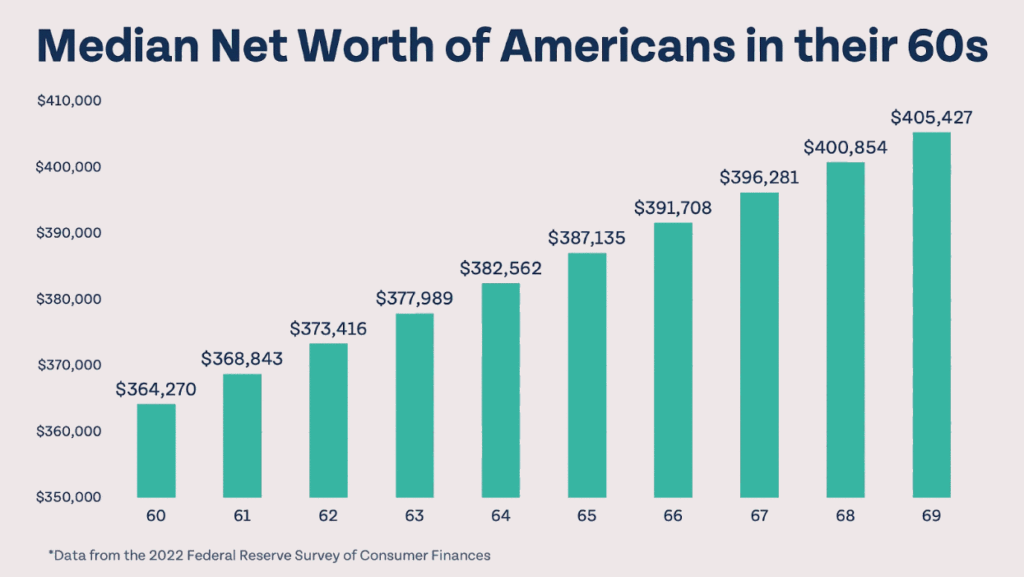
    (Chart: Median net worth by age in the 60s—notice how it climbs steadily with discipline. Most Americans never hit these levels because they never track.)

    Why Net Worth Beats Income Every Time

    High earners stay broke because they confuse cash flow with wealth. Six-figure salary? Cool. But if liabilities grow faster than assets, you’re just a well-paid tenant in your own life.

    I learned this the hard way: Biggest money mistake in my 20s was chasing income spikes without protecting the balance sheet. Fixed it by obsessing over net worth growth, not just bank balance.

    Track it monthly and watch:

    • Paying down debt accelerates growth faster than most raises.
    • Investing consistently compounds quietly (see my compounding post).
    • Lifestyle creep kills it—new toys inflate liabilities or drain assets.

    Cash flow keeps you alive day-to-day. Net worth tells you if you’re actually getting freer.

    Average Net Worth By Age – How Americans Stack Up | Money Guy

    moneyguy.com

    Average Net Worth By Age – How Americans Stack Up | Money Guy

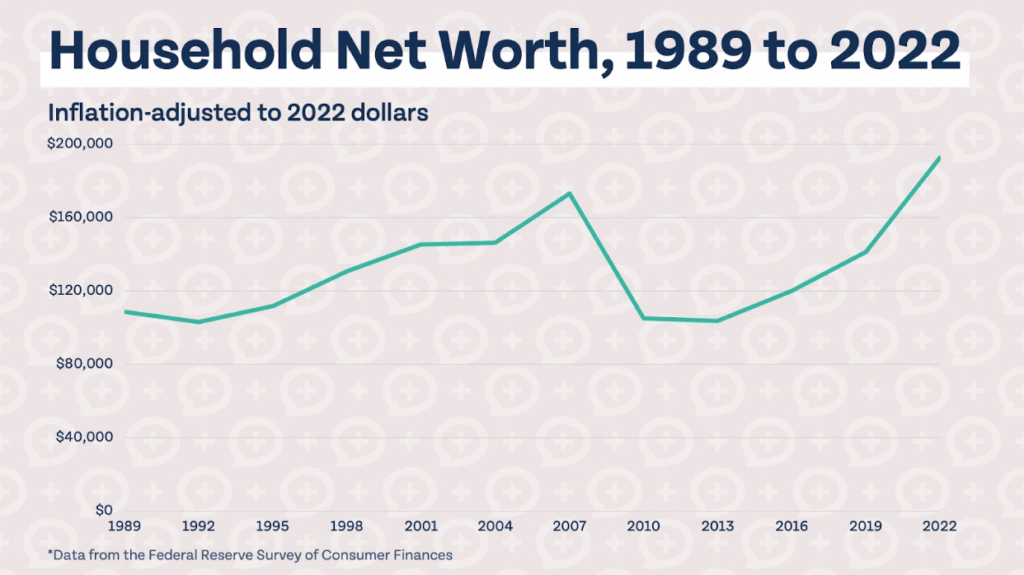
    (Chart: U.S. household net worth over decades, inflation-adjusted. Dips happen—recessions, bad decisions—but the trend rewards patience and boring consistency.)

    How to Build and Use Your Own Net Worth Calculator

    1. Grab a free online tool (NerdWallet, Bankrate, or Personal Capital for auto-syncing) or make a simple Google Sheet/Excel.
    2. List everything honestly—appraise assets at what they’d sell for today, not what you wish.
    3. Update monthly (takes 15 minutes).
    4. Set targets: Zero debt outside mortgage by 35? $500k by 40? $1M by 50? Make it specific.
    5. Review quarterly: What’s growing fastest? What’s dragging? Adjust.

    My rules:

    • Never celebrate income jumps until net worth reflects them.
    • Build that $10k “screw you” fund first—it’s an asset, not a spending pool.
    • Focus on boring levers: Max retirement contributions, side hustle profits into index funds, real estate cash flow.
    • Ignore the noise—net worth doesn’t care about viral posts or “opportunities.”

    The Bottom Line

    A net worth calculator strips away the illusions. It shows if you’re climbing the discipline ladder or sliding back into comfort.

    Most stay broke even making good money because they never measure the real score. I stopped that game early. Started tracking, started winning.

    What’s your number right now? Positive? Negative? Stagnant? Drop it in the comments (or keep it private and just tell me the direction it’s moving). I’ll give you Forge-style feedback—no sugarcoating, just what moves the needle.

    Calculate it today. Then do it again next month. The gap between those two numbers? That’s your real progress.

    Pay the discipline tax early. The scoreboard doesn’t lie.

    — Jaxon Forge Founder, MoneyForge.com

  • Savings Goal & Retirement Timeline Calculator

    Savings Goal & Retirement Timeline Calculator

    Savings Goal Calculator | MoneyForge Fixed

    Savings Goal & Retirement Timeline

    “Most guys in their 30s/40s grind hard but never run the real numbers on retirement. This simple Savings Goal Calculator changes that. Plug in your target (e.g., $1–2M for true freedom in America), conservative return (7–9%), years left, and current stack—it spits out exactly how much you need to auto-transfer monthly to hit it. No hype, no crypto moonshots—just the compounding math most ignore until it’s too late. Defaults show ~$2,400/mo from $50k today to $1M in 15 years at 8%. Discipline tax paid early = freedom later. Copy the HTML, run your numbers, and start the transfer this week. Systems beat motivation. What’s your goal number looking like?” – Jaxon